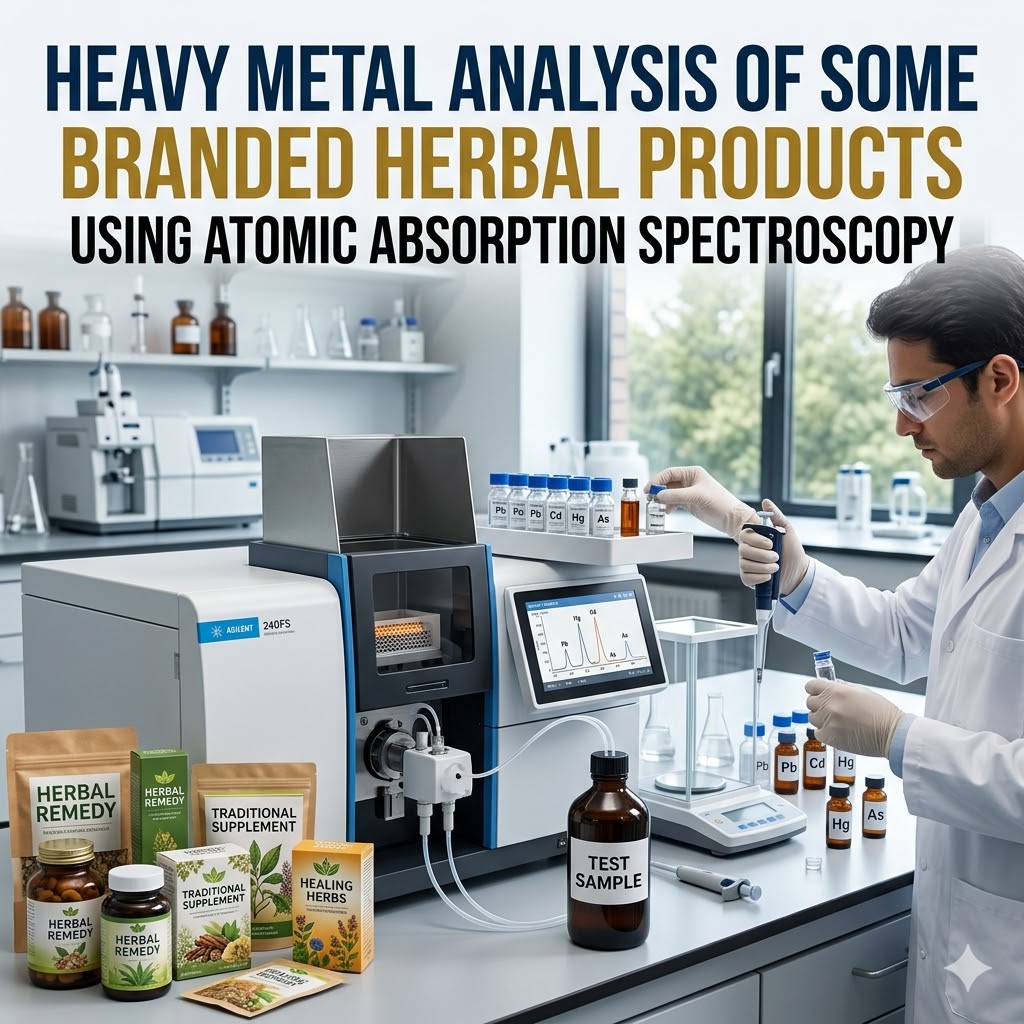
Heavy Metal Analysis of Some Branded Herbal Products Using Atomic Absorption Spectroscopy
DOI:
https://doi.org/10.59493/advpbl/2026.1.2Keywords:
Herbal products; Heavy metals; Atomic Absorption Spectroscopy; CarcinogenAbstract
Herbal products are preparations made from medicinal plants which contribute significantly to traditional medicine, having a long- lasting history of therapeutic application worldwide. The quality and safety of herbal products have become a significant concern, particularly regarding contamination from heavy metals. This research investigated the prevalence and concentration of heavy metals, specifically cadmium, chromium, lead, nickel, and iron in selected herbal products (labeled P1- P9) using atomic absorption spectroscopy for precise quantification. The samples were prepared by treating with concentrated HNO3 and HCl. After treatment and filtration, the samples were examined using an Atomic Absorption Spectrometer. The samples were analyzed three times to ensure accuracy and precision. Statistical significance was defined as a P-value of less than 0.05. Quantitative analysis of herbal product samples selected confirmed the presence and concentrations (mg/L) of lead (0.0435 – 1.6163), cadmium (0.0060-0.1477), chromium (0.0042- 0.4317), nickel (0.0141-0.0640), and iron (0.5339-12.1509). The results showed that lead, cadmium, chromium, and iron were above permissible limits of consumption in all the samples analyzed. The result underscores the importance of quality control measures during the processing and production of these herbal products, considering the potential for long-term accumulation and synergistic toxic effects of multiple heavy metals.
References
Luo L, Wang B, Jiang J, Fitzgerald M, Huang Q, Zheng Y, Li H, Zhang J, Wei J, Yang C, Zhang H, Dong L, Chen S, 2021. Heavy Metal Contaminations in Herbal Medicines: Determination, Comprehensive Risk Assessments, and Solutions. Frontiers in Pharmacology, 11:595335. https://doi.org/10.3389/fphar.2020.595335
Jurowski K, Krośniak M, 2022. The Human Health Risk Assessment of Heavy Metals Impurities (Cd and Pb) in Herbal Medicinal Products as Menthae piperitae tinctura (Mentha × piperita L., folium) Available in Pharmacies from Poland. Toxics, 10(5):273. https://doi.org/10.3390/toxics10050273
Islam N, Zamir R, Faruque O, 2024. Health Risk Assessment of Toxic Metal(loids) Consumed Through Plant-Based Anti-diabetic Therapeutics Collected in the Northern Divisional City of Rajshahi, Bangladesh. Biological Trace Element Research. https://doi.org/10.1007/s12011-024-04338-7
Abdulla NM, Ádam B, Blair I, Oulhaj A, 2019. Heavy metal content of herbal health supplement products in Dubai – UAE: a cross-sectional study. BMC Complementary and Alternative Medicine, 19(1):2693. https://doi.org/10.1186/s12906-019-2693-3
Kenny C, Ring GO, Sheehan A, Auliffe MAPM., Lucey B, Furey A, 2022. Novel metallomic profiling and non-carcinogenic risk assessment of botanical ingredients for use in herbal, phytopharmaceutical, and dietary products using HR-ICP-SFMS. Scientific Reports, 12(1):16873. https://doi.org/10.1038/s41598-022-16873-1
Ćwieląg‐Drabek M, Piekut A, Szymala I, Oleksiuk K, Razzaghi M, Osmala-Kurpiewska W, Jablonska K, Dziubanek G, 2020. Health risks from the consumption of medicinal plant dietary supplements. Food Science & Nutrition, 8(7):3535-3545. https://doi.org/10.1002/fsn3.1636
Geronimo ACR, Melo ESP, Silva KRN, Pereira HS, Nascimento VA, Machate DJ, Nascimento VA, 2021. Human Health Risk Assessment of Heavy Metals and Metalloids in Herbal Medicines Used to Treat Anxiety: Monitoring of Safety. Frontiers in Pharmacology, 12:772928. https://doi.org/10.3389/fphar.2021.772928
Wang H, Chen Y, Wang L, Liu Q, Yang S, Wang CQ, 2023. Advancing herbal medicine: enhancing product quality and safety through robust quality control practices. Frontiers in Pharmacology, 14:1265178. https://doi.org/10.3389/fphar.2023.1265178
Sajnóg A, Koko E, Kayzer D, Barałkiewicz D, 2021. Chemometric approach to find relationships between physiological elements and elements causing toxic effects in herb roots by ICP-MS. Scientific Reports, 11(1):00019. https://doi.org/10.1038/s41598-021-00019-w
Leong F, Xue H, Wang M, Chen T, Song Y, Tu P, Chen X, 2020. Quality standard of traditional Chinese medicines: comparison between European Pharmacopoeia and Chinese Pharmacopoeia and recent advances. Chinese Medicine, BioMed Central, 15(1):57. https://doi.org/10.1186/s13020-020-00357-3
Singh R, Gautam N, Mishra A, Gupta R, 2011. Heavy metals and living systems: An overview. Indian Journal of Pharmacology, 43(3):246–253. https://doi.org/10.4103/ijpharm/ijpharm_75_19
Mititelu M, Neacșu SM, Busnatu Ștefan, Scafa‐Udriște A, Andronic O, Lacraru A, Ioniță-Mîndrican CB, Lupuliasa D, Negrei C, Olteanu G, 2025. Assessing Heavy Metal Contamination in Food: Implications for Human Health and Environmental Safety Toxics, 13(5):333. https://doi.org/10.3390/toxics13050333
Jomová K, Alomar SY, Nepovimová E, Kuča K, Valko M, 2024. Heavy metals: toxicity and human health effects. Archives of Toxicology. Springer Science Business Media. https://doi.org/10.1007/s00204-024-03903-2
Ismaël BM, Siaka S, 2022. The Toxicity of Environmental Pollutants. In IntechOpen eBooks. IntechOpen. https://doi.org/10.5772/intechopen.104088
Ortega DR, González‐Esquivel DF, Ayala TB, Pineda B, Gómez‐Manzo S, Marcial‐Quino J, Carrillo‐Mora P, Cruz VP de la, 2021. Cognitive Impairment Induced by Lead Exposure during Lifespan: Mechanisms of Lead Neurotoxicity. Toxics, 9(2):23. https://doi.org/10.3390/toxics9020023
Ferreira G, Santander A, Chavarría L, Cardozo R, Savio F, Sobrevía L, Nicolson GL, 2021. Functional consequences of lead and mercury exposomes in the heart. Molecular Aspects of Medicine, 87:101048. https://doi.org/10.1016/j.mam.2021.101048
Berhanu G, Lemma H, Mekonnen S, Dadi D, 2024. Heavy metals in wastewater and fish collected from the waste stabilization pond and human health risks in southwestern Ethiopia. Frontiers in Environmental Health, 3:1386827. doi: 10.3389/fenvh.2024.1386827
Glicklich D, Frishman WH, 2021. The Case for Cadmium and Lead Heavy Metal Screening. The American Journal of the Medical Sciences, 362(4):344-350. https://doi.org/10.1016/j.amjms.2021.05.019
Cai L, Holm RH, Biddle DJ, Zhang CH, Talley D, Smith T, States JC, 2023. Wastewater-based epidemiology for comprehensive communitywide exposome surveillance: A gradient of metals exposure. (Cold Spring Harbor Laboratory). https://doi.org/10.1101/2023.09.26.23295844
Goldberg I, Sheiner E, Bal MH, Bergman D, Damri NT, Rosenbaum R, Haimov A, Wainstock T, 2024. Early pregnancy metal levels in maternal blood and pregnancy outcomes. Scientific Reports, 14(1):79107. https://doi.org/10.1038/s41598-024-79107-6
Kou X, Iglesias‐Vázquez L, Nadal M, Basora J, Arija V, 2023. Urinary concentrations of heavy metals in pregnant women living near a petrochemical area according to the industrial activity. Environmental Research, 235:116677. https://doi.org/10.1016/j.envres.2023.116677
Imran I, Khan AA, Kamal A, Alrefaei AF, Zaman W, 2024. Utilization and Characterization of Microbes for Heavy Metal Remediation. Polish Journal of Environmental Studies. https://doi.org/10.15244/pjoes/186937
Balali‐Mood M., Naseri K, Tahergorabi Z, Khazdair MR, Sadeghi M, 2021. Toxic Mechanisms of Five Heavy Metals: Mercury, Lead, Chromium, Cadmium, and Arsenic. Frontiers in Pharmacology, 12: 643972. https://doi.org/10.3389/fphar.2021.643972
Mohammadpour A, Rajabi S, Emmons‐Bell S, Baghapour MA, Aliyeva A, Khaneghah AM, 2023. Seasonal variations of potentially toxic elements (PTEs) in drinking water and health risk assessment via Monte Carlo simulation and Sobol sensitivity analysis in southern Iran’s largest city. Applied Water Science, 13(12):2041. https://doi.org/10.1007/s13201-023-02041-x
Raza-Naqvi SA, Idrees F, Sherazi TA, Anjum-Shahzad S, Ul-Hassan S, Ashraf N, 2022. Toxicology of heavy metals used in cosmetics. Journal of the Chilean Chemical Society, 67(3):5615 - 5622. https://doi.org/10.4067/s0717-97072022000305615
Brzezińska-Rojek J, Rutkowska M, Ośko J, Konieczka P, Prokopowicz M, Grembecka M, 2023. Evaluation of the Safety and Potential Benefits of Beetroot-Based Dietary Supplements According to Their Elemental Composition. Biological Trace Element Research, 202(7):3318 - 3332. https://doi.org/10.1007/s12011-023-03902-x
Ahmad W, Alharthy RD, Zubair M, Ahmed M, Hameed A, Rafique S, 2021. Toxic and heavy metals contamination assessment in soil and water to evaluate human health risk. Scientific Reports, 11(1):94616. https://doi.org/10.1038/s41598-021-94616-4
Fernández-Martos S, Calvo-Sánchez MI, Lobo-Aldezabal A, Adrada AIS, Moreno C, Vitale M., Espada J, 2021. The deleterious effects induced by an acute exposure of human skin to common air pollutants are prevented by extracts of Deschampsia antarctica. Scientific Reports, 11(1):03190. https://doi.org/10.1038/s41598-021-03190-2
Covino J, Sugden KD, 2008. Chapter 1 Genotoxicity of Chromate. In Advances in molecular toxicology. Elsevier BV. https://doi.org/10.1016/s1872-0854(07)02001-2
Shin DY, Lee SM, Jang Y, Lee J, Lee CM, Cho EM, Seo YR, 2023. Adverse Human Health Effects of Chromium by Exposure Route: A Comprehensive Review Based on Toxicogenomic Approach. International Journal of Molecular Sciences, 24(4):3410. https://doi.org/10.3390/ijms24043410
Lan CH, Ou LC, Liu H, Peng C, 2024. Investigation of metal concentration distribution and corresponding health exposure assessment of fabricated metal product manufacturers. Scientific Reports, 14(1):64277. https://doi.org/10.1038/s41598-024-64277-0
Kasprzak KS, 2003. Nickel carcinogenesis. Mutation Research/Fundamental and Molecular Mechanisms of Mutagenesis, 533:67-97. https://doi.org/10.1016/j.mrfmmm.2003.08.021
Begum W, Rai S, Banerjee S, Bhattacharjee S, Mondal MH, Bhattarai A, Saha B, 2022. A comprehensive review of the sources, essentiality, and toxicological profile of nickel. Royal Society of Chemistry Advances, 12(15):9139-9153. https://doi.org/10.1039/d2ra00378c
Maric D, Baralić K, Javorac D, Mandić‐Rajčević S, Žarković M, Antonijević B, Đukić-Ćosić D, Bulat Z, Djordjević AB, 2023. Nickel as a potential disruptor of thyroid function: benchmark modelling of human data. Frontiers in Endocrinology, 14:1145153. https://doi.org/10.3389/fendo.2023.1145153
Ewona IO, Ekah BJ, Akwagiobe JU, Udo SO, Rabiu AB, 2024. Evaluation of Chemical and Elemental Analyses of Airborne Particulate Matter in Nigeria. Research Square. https://doi.org/10.21203/rs.3.rs-5105755/v1
Zhao Y, Yang M, Liang X, 2024. The role of mitochondria in iron overload-induced damage. Journal of Translational Medicine, 22(1):5740. https://doi.org/10.1186/s12967-024-05740-4
Martínez-Hernández MI, Acosta‐Saavedra LC, Hernández‐Kelly LC, Loaeza‐Loaeza J, Ortega A 2023. Microglial Activation in Metal Neurotoxicity: Impact on Neurodegenerative Diseases. BioMed Research International, 1:7389508. https://doi.org/10.1155/2023/7389508
Garza-Lombó C, Posadas Y, Quintanar L, Gonsebatt ME, Franco R, 2018. Neurotoxicity Linked to Dysfunctional Metal Ion Homeostasis and Xenobiotic Metal Exposure: Redox Signaling and Oxidative Stress. Antioxidants and Redox Signaling, 28(18):1669-1703. https://doi.org/10.1089/ars.2017.7272
Li H, Mu Q, Kang Y, Yang X, Shan L, Wang M, Li C, Liu Y, Wang F, 2021. Association of Cigarette Smoking with Male Cognitive Impairment and Metal Ions in Cerebrospinal Fluid. Frontiers in Psychiatry, 12:738358. https://doi.org/10.3389/fpsyt.2021.738358
Downloads
Published
How to Cite
Issue
Section
License
Copyright (c) 2026 Chinwe M. Onah, Ebuka R. Ikegbulam, Martin O. Omeje, Philip F. Uzor

This work is licensed under a Creative Commons Attribution 4.0 International License.
All articles published in Advanced Pharmaceutical and Biomedical Letters (AdvPBL) are distributed under an Open Access Creative Commons License BY/4.0. Users are allowed to freely download, read, distribute the materials in any medium or format, remix, reuse the articles or quote the articles, so long as proper attribution is given to the original creators (authors and publishers). Articles may be used for commercial or non-commercial purposes. Users are free to disseminate the work to colleagues or wider scientific community. By submitting their article, the author(s) grant publisher permission to publish, including displaying, storing, copying, and reusing their content.