Isolation and Characterization of Carbapenamase-Producing Klebsiella spp from Formites in Madonna University, Elele
DOI:
https://doi.org/10.59493/advpbl/2025.1.5Keywords:
Antimicrobial resistance; Carbapenemase; Environmental reservoirs; Fomites; Healthcare-associated infections; Madonna University; Multidrug resistanceAbstract
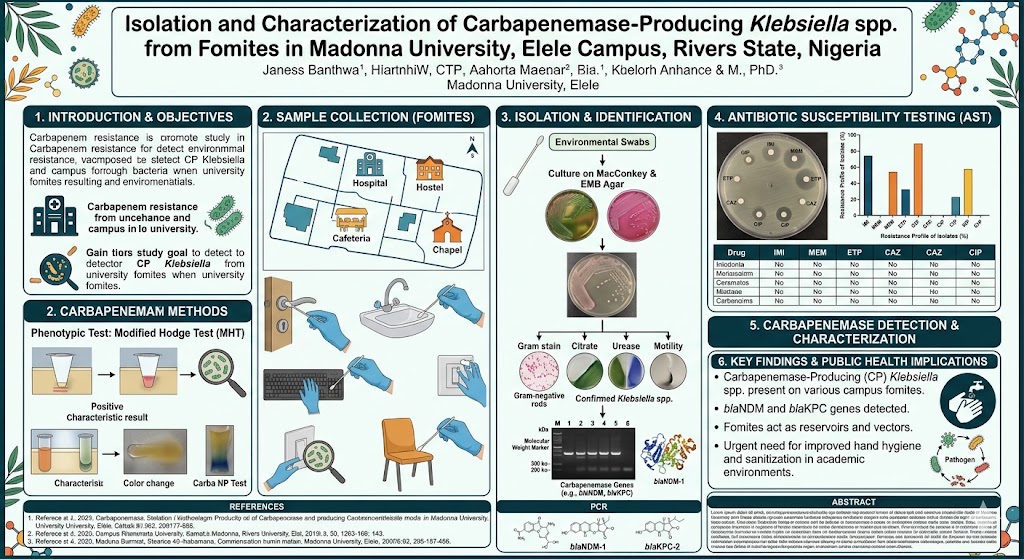
Carbapenemase-producing Klebsiella spp. (CPK) constitutes a serious public health hazard owing to their multidrug-resistant characteristics, limiting treatment choices, and worsening healthcare difficulties. This work is intended to identify and characterize CPK from fomites at Madonna University, Elele, Nigeria. One hundred (100) samples were collected aseptically from four locations: the girls' hostel, the boys' hostel, the hospital area, and the church area at Madonna University, Elele Campus. Using nutritional broth and Eosin Methylene Blue agar, Klebsiella spp. were identified based on colonial appearance and biochemical properties. Twelve antibiotics were used for an antibiotic susceptibility test conducted on Mueller-Hinton Agar, utilising the disc diffusion method. Results showed that the prevalence of Klebsiella spp. was 35%, distributed uniformly throughout the studied locales. Alarmingly, all isolates indicated Multidrug resistance (MDR), including 100% resistance to Amoxicillin/Clavulanate, Nalidixic Acid, and Nitrofurantoin. Imipenem demonstrated the greatest susceptibility rate at 22.9%. Carbapenemase production was found in 11.4% of isolates, limited to the girls' hostel and hospital regions. Statistical analysis revealed no significant difference in the occurrence of Klebsiella sp. across sites (p = 0.3175), suggesting broad environmental contamination. The results underline the critical need for antimicrobial stewardship and better infection control procedures. Additionally, the research reveals the environmental reservoirs of CPK, underlining the crucial function of fomites in pathogen spread across hospital and community settings. This work adds significant data to assist treatments aimed at reducing the development of Multi Drug Resistant (MDR) Klebsiella spp. It illustrates the necessity of focused policies for antibiotic usage and hygiene management in institutional contexts.
References
Galarde-López M, Velazquez-Meza ME, Bobadilla-del-Valle M, Carrillo-Quiroz BA, Cornejo-Juárez P, Ponce-de-León A, Sassoé-González A, Alpuche-Aranda CM, 2022. Surveillance of antimicrobial resistance: Identification of carbapenemase-producing Klebsiella spp. Antibiotics, 11(3): 288.
Gu D, Dong N, Zheng Z, Lin D, Huang M, Wang L, Chan EW, Shu L, Yu J, Zhang R, Chen S, 2018. A fatal outbreak of ST11 carbapenem-resistant hypervirulent Klebsiella pneumoniae in a Chinese hospital: A molecular epidemiological study. The Lancet Infectious Diseases, 18(1): 37–46.
Russo TA, Marr CM, 2019. Hypervirulent Klebsiella pneumoniae. Clinical Microbiology Reviews, 32(3): e00001–e00019.
Magondu RN, Ramesh GP, Kiprono SJ, 2022. Isolation and identification of bacteria present on frequently used fomites in University of Eastern Africa Baraton in Nandi County Kenya. Journal of Research Innovation and Implications in Education, 6(2): 382–388.
Wilkie ED, Oluduro AO, Sotala TT, 2022. Antibiotic susceptibility profile of bacteria isolated from fomites in some daycare centers in Ile-Ife Nigeria. African Journal of Microbiology Research, 16(4): 132–139.
Amjad A, Mirza IA, Abbasi S, Farwa U, Malik N, Zia F, 2011. Modified Hodge test: A simple and effective test for detection of carbapenemase production. Iranian Journal of Microbiology, 3(4): 189–193.
Codjoe FS, Donkor ES, 2017. Carbapenem resistance: A review. Medical Sciences (Basel Switzerland, 6(1): 1.
Aghanya IN, Akujobi CN, Ushie SN, Ubajaka CF, Ajuba IM, Ezeama CJ, Maduekwe NP, Uzoewulu NG, Chigbo CG, 2021. Carbapenemase-producing Klebsiella pneumoniae isolated from environmental sources in a tertiary health institution in Nigeria. Journal of Applied Environmental Microbiology, 9(1): 22–27.
Mohamed ER, Aly SA, Halby HM, Ahmed SH, Zakaria AM, El-Asheer OM, 2017. Epidemiological typing of multidrug-resistant Klebsiella pneumoniae which causes pediatric ventilator-associated pneumonia in Egypt. Journal of Medical Microbiology, 66: 628–634. https://doi.org/10.1099/jmm.0.000498
Abdallah S, Zaki S, Hafez S, Moustafa E, 2018. Prevalence rate of Klebsiella pneumoniae in the intensive care unit: epidemiology and molecular characteristics. Journal of Biological Research - Bollettino Della Società Italiana Di Biologia Sperimentale, 91(1): 2018.
Okoche D, Asiimwe BB, Katabazi FA, Kato L, Najjuka CF, 2015. Prevalence and characterisation of carbapenem-resistant Enterobacteriaceae isolated from Mulago National Referral Hospital Uganda. PLoS ONE, 10(8): e0135745.
Martin RM, Bachman MA, 2018. Colonization Infection and the Accessory Genome of Klebsiella pneumonia. Frontiers in Cellular and Infection Microbiology, 22: 8:4.
Struve C, Krogfelt KA, 2004. Pathogenic potential of environmental Klebsiella pneumoniae isolates. Environmental Microbiology, 6: 584–590.
Osuala OJ, Maduakor GJ, Ezemba CC, Etikudike VO, Ike VE, Nnadi CO, Oli AN, 2025. Isolation and Characterisation of Carbapenemase-Producing Escherichia coli Isolates from Fomites in Madonna University Elele Campus Rivers State Nigeria. Advanced Pharmaceutical and Biomedical Letters, 2: 13-19.
Ferreira RL, da Silva BCM, Rezende GS, Nakamura-Silva R, Pitondo-Silva A, Campanini EB, Brito MCA, da Silva EML, Freire CCM, Cunha AF, Pranchevicius MC, 2019. High Prevalence of Multidrug-Resistant Klebsiella pneumoniae Harboring Several Virulence and β-Lactamase Encoding Genes in a Brazilian Intensive Care Unit. Frontiers in. Microbiology, 9:3198.
Downloads
Published
How to Cite
Issue
Section
License
Copyright (c) 2025 Oluchi J. Osuala, Yochi F. Soronnadi, Chinyere C. Ezemba, Victor O. Etikudike, Victor E. Ike, Charles O. Nnadi, Angus N. Oli

This work is licensed under a Creative Commons Attribution 4.0 International License.
All articles published in Advanced Pharmaceutical and Biomedical Letters (AdvPBL) are distributed under an Open Access Creative Commons License BY/4.0. Users are allowed to freely download, read, distribute the materials in any medium or format, remix, reuse the articles or quote the articles, so long as proper attribution is given to the original creators (authors and publishers). Articles may be used for commercial or non-commercial purposes. Users are free to disseminate the work to colleagues or wider scientific community. By submitting their article, the author(s) grant publisher permission to publish, including displaying, storing, copying, and reusing their content.