Isolation and Characterisation of Carbapenemase-Producing Escherichia coli Isolates from Fomites in Madonna University, Elele Campus, Rivers State, Nigeria
DOI:
https://doi.org/10.59493/advpbl/2025.1.3Keywords:
Antibiotic resistance; Carbapenemase; Multidrug resistance; Fomites; Environmental contamination; HygieneAbstract
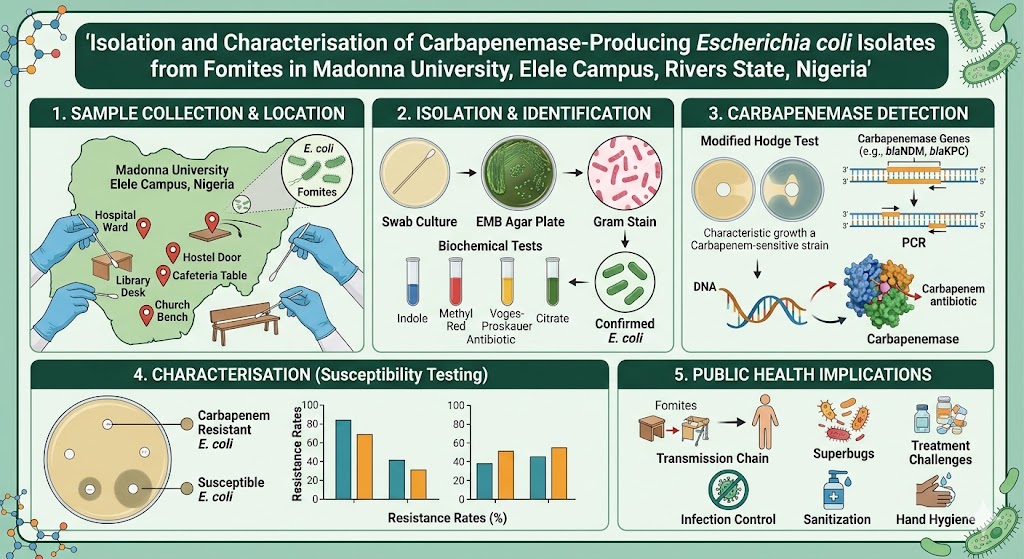
The rise of carbapenem-resistant bacteria exemplifies a significant worldwide health concern due to antibiotic resistance. This research examined the prevalence and antimicrobial resistance profiles of carbapenemase-producing Escherichia coli (CPE) obtained from fomites at Madonna University, Elele Campus, Rivers State, Nigeria. One hundred swab samples were obtained from commonly touched surfaces at five sites: hospital, school, church, boys' hostel, and girls' hostel. Samples were cultivated using conventional microbiological procedures, and antibiotic susceptibility was assessed utilizing the Kirby-Bauer disc diffusion method. The Modified Hodge Test was used to evaluate carbapenemase production. Of 100 samples, 8% produced E. coli isolates, with the hospital area exhibiting the greatest incidence at 12%. Antibiotic susceptibility tests demonstrated significant multidrug resistance (MDR), with all isolates displaying a multiple antibiotic resistance (MAR) index over 0.2. The highest MAR values (0.9–1.0) were recorded in isolates from the hospital vicinity. Resistance was particularly severe against beta-lactams (Ampiclox, Cefuroxime, and Cefotaxime), whereas Ofloxacin displayed the maximum effectiveness. Nonetheless, none of the isolates exhibited good results for carbapenemase synthesis. The results reinforce fomites' importance as potential MDR bacteria reservoirs and highlight the hospital area as a key contamination hotspot. The research underlines the critical need for increased hygiene standards, frequent environmental monitoring, and antibiotic stewardship to limit the emergence of resistant bacteria in academic contexts.
References
Elshamy AA, Aboshanab KM, 2020. A review on bacterial resistance to carbapenems: epidemiology, detection and treatment options. Future Science OA, 6(3): FSO438.
Meletism G, 2016. Carbapenem resistance: overview of the problem and future perspectives. Therapeutic Advances in Infectious Diseases, 3(1):15-21.
Aurilio C, Sansone P, Barbarisi M, Pota, V, Giaccari LG, Coppolino F, Barbarisi A, Passavanti MB, Pace MC, 2022. Mechanisms of Action of Carbapenem Resistance. Antibiotics (Basel), 11(3):421.
Nordmann P, Naas T, Poirel L, 2011. Global spread of carbapenemase-producing Enterobacteriaceae. Emerging Infectious Diseases, 17(10): 1791–1798.
Hay M, Thomas D, Craighead J, Economides C, Rosenthal J, 2014. Clinical development success rates for investigational drugs. Nature Biotechnology, 32: 40–51.
Timothy RJ, Luke HM, Yayi G, Sara JM, Kosek M, Yori PP, Pinedo SR, Schwab KJ, 2013. Faecal Indicator Bacteria Contamination of Fomites and Household Demand for Surface Disinfection Products: A Case Study from Peru. The American Journal of Tropical Medicine and Hygiene, 89(5):869-872.
Akinrotoye KP, Bankole MO, Akinola SO, 2018. Occurrence of Pathogenic Bacteria on Public Surfaces within community schools in Abeokuta Environs Ogun State. Journal of Environmental Treatment Techniques, 6(3):47-52
Joanna V, 2012. School of Healthcare Science, Manchester Metropolitan University, Manchester, the Microbial Contamination of Mobile Communication Devices. Journal of Microbiology and Biology Education, 13(1):59-61.
Boone SA, Gerba CP, 2007. Significance of fomites in the spread of respiratory and enteric viral disease. Applied and Environmental Microbiology, 73(6): 1687–1696.
Rodrigues A, Pinto BD, Sitta Peres M, Gomes TAT, 1998. Detection of rotavirus on surfaces and in the air of a hospital during an outbreak. Journal of Hospital Infection, 39(4): 339–345.
Magondu RN, Ramesh GP, Kiprono SJ, 2022. Isolation and identification of bacteria present on frequently used fomites in the University of Eastern Africa Baraton in Nandi County, Kenya. Journal of Research Innovation and Implications in Education, 6(2): 382–388.
Clinical and Laboratory Standard Institute. 2016. Performance standards for antimicrobial susceptibility testing. Wayne, PA: CLSI.
Wilkie ED, Oluduro AO, Sotala TT, 2022. Antibiotic susceptibility profile of bacteria isolated from fomites in some daycare centres in Ile-Ife, Nigeria. African Journal of Microbiology Research, 16(4): 132-139.
Amjad A, Mirza I, Abbasi S, Farwa U, Malik N, Zia F, 2011. Modified Hodge test: A simple and effective test for detection of carbapenemase production. Iranian Journal of Microbiology, 3(4): 189–193.
Okeke IN, Laxminarayan R, Bhutta ZA, Duse AG, Jenkins P, O’Brien TF, 2005. Antimicrobial resistance in developing countries. Part I: recent trends and current status. Lancet Infectious Disease, 5(8):481–93.
Moges F, Endris M, Mulu A, Tessema B, Belyhun Y, Shiferaw Y, 2014. The growing challenges of antibacterial drug resistance in Ethiopia. Journal of Global Antimicrobial Resistance, 2(3):148–54.
Kabugo D, Kizito S, Ashok DD, 2016. Factors associated with community-acquired urinary tract infections among adults attending assessment centre, Mulago Hospital Uganda. African Health Sciences 16(4):1131–1142.
Mwaka AD, Mayanja-Kizza H, Kigonya E, Kaddu-Mulindwa D, 2011. Bacteriuria among adult non-pregnant women attending Mulago Hospital Assessment Centre in Uganda. African Health Sciences, 11(2):182–189.
Navab-Daneshmand T, Friedrich MND, Gächter M, 2018. Escherichia coli contamination across multiple environmental compartments (soil, hands, drinking water, and hand washing water) in urban Harare: Correlations and risk factors. American Journal of Tropical Medicine and Hygiene, 98(3):803-13.
Ikede RE, Iyevhobu KO, Barnabas FO, Ibrahim SM, Abinokhauno S, 2022. Bacteriological Assessment of Door Handles and Knobs at The Federal School of Medical Laboratory Technology Offices in Jos. American Journal of Biomedical Science and Research, 17(5) AJBSR.MS.ID.002387,
Agu C, Aaron S, Akinseye J, Eya C P, Ogunfolakan O, Egbebi A, Oluboyo B, 2024. Bacterial Isolation, Identification and Antibiogram of Frequently Used Fomite in a Tertiary Hospital in Ado-Ekiti, Ekiti State, Nigeria. The Nigerian Health Journal, 24(4): 1799–1808.
Irek EO, 2018. A systematic review of healthcare-associated infections in Africa: An antimicrobial resistance perspective. African Journal of Laboratory Medicine, 7(2): 1–9.
Yallew WW, Kumie A, Yehuala FM, 2019. Point prevalence of hospital-acquired infections in two teaching hospitals of Amhara region in Ethiopia. Drug, Healthcare and Patient Safety, 8(2):71- 75
Rakhalaru P, Munzhedzi L, Abia AL, Kabue JP, Potgieter N, Traore AN, 2023. Prevalence and Antimicrobial Resistance Profile of Diarrheagenic Escherichia coli from Fomites in Rural Households in South Africa. Antibiotics, 12(8): 1345.
Naqid IA, Balatay AA, Hussein NR, Saeed KA, Ahmed HA, Yousif SH, 2020. Antibiotic Susceptibility Pattern of Escherichia coli Isolated from Various Clinical Samples in Duhok City, Kurdistan Region of Iraq. International Journal of Infection, 7(3):e103740.
Goswami, NN, Trivedi HR, Goswami AP, Patel TK, Tripathi CB, 2011. Antibiotic sensitivity profile of bacterial pathogens in postoperative wound infections at a tertiary care hospital in Gujarat, India. Journal of Pharmacology and Pharmacotherapeutics, 2(3): 158–164.
Ayalew W, Mulu W Biadglegne F, 2019. Bacterial contamination and antibiogram of isolates from health care workers’ fomites at Felege Hiwot Referral Hospital, Northwest Ethiopia. Ethiopian Journal of Health Development, 32(2): 128-141
Breijyeh Z, Jubeh B, Karaman R, 2020. Resistance of Gram-negative bacteria to current antibacterial agents and approaches to resolve it. Molecules, 25(6), 1340-147.
Recalde-Reyes, DP, Alfonso-Ortiz, N. Fuentes-Quimbayo, MF, 2021. Genotypic and phenotypic resistance profile present in bacteria isolated from fomites in Armenia, Quindío Colombia period June-July 2019. Infection, 25(1): 22-27.
Kraemer SA, Ramachandran A, Perron GG, 2019. Antibiotic pollution in the environment: From microbial ecology to public policy. Microorganisms, 7(6), 180-187.
Rotchell D, Paul D, 2016. Multiple Antibiotic Resistance Index. Fitness and Virulence Potential in Respiratory Pseudomonas aeruginosa from Jamaica. Journal of Medical Microbiology, 65:251–271.
Ayandele, AA, Oladipo, EK, Oyebisi O, Kaka MO, 2020. Prevalence of Multi-Antibiotic Resistant Escherichia coli and Klebsiella species obtained from a Tertiary Medical Institution in Oyo State, Nigeria. Qatar Medical Journal. 1:9
Joseph AA, Odimayo MS, Olokoba LB, Olokoba AB, Popoola GO, 2017. Multiple antibiotic resistance index of Escherichia coli isolates in a tertiary hospital in South-West Nigeria. Medical Journal of Zambia, 44(4): 225- 232.
Krumperman PH, 1983. Multiple antibiotic resistance indexing of Escherichia coli to identify high-risk sources of faecal contamination of Food. Applied and Environmental Microbiology, 46(1): 165- 170.
Ibrahim ME, Bilal NE, Hamid ME, 2012. Increased multidrug-resistant Escherichia coli from hospitals in Khartoum state, Sudan. African Health Sciences, 12(3): 368-375.
Shams F, Hasani A, Pormohammad A, Rezaee MA, Reza M, Nahaie AH, 2014. An implicated quinolone resistance in Escherichia coli and Klebsiella pneumoniae clinical isolates from a University Teaching Hospital. Life Science Journals, 11(12): 112.
Wuna, MM, Enejiyon SO, Dawud I, Fasasi RA, Adabara NU, 2023. Investigation of Multidrug-Resistant Escherichia coli on medical equipment and surfaces from selected hospitals in Minna, Nigeria. Scientia Africana, 22 (3): 199-210.
Bassey EE, Tarh JE, Otu JU, Ekpiken ES, 2022. Antibiogram Profile of Enteric Pathogens Isolated from Fomites in Cross River University of Technology Medical Centre, Calabar, Nigeria. Annual Research & Review in Biology, 37(1): 21-36.
Reygaert, WC, 2018. An overview of the antimicrobial resistance mechanisms of bacteria. AIMS Microbiology, 4(3), 482.
Downloads
Published
How to Cite
Issue
Section
License
Copyright (c) 2025 Oluchi J. Osuala, Jennifer G. Maduakor, Chinyere C. Ezemba, Victor O. Etikudike, Victor E. Ike, Charles O. Nnadi, Angus N. Oli

This work is licensed under a Creative Commons Attribution 4.0 International License.
All articles published in Advanced Pharmaceutical and Biomedical Letters (AdvPBL) are distributed under an Open Access Creative Commons License BY/4.0. Users are allowed to freely download, read, distribute the materials in any medium or format, remix, reuse the articles or quote the articles, so long as proper attribution is given to the original creators (authors and publishers). Articles may be used for commercial or non-commercial purposes. Users are free to disseminate the work to colleagues or wider scientific community. By submitting their article, the author(s) grant publisher permission to publish, including displaying, storing, copying, and reusing their content.