Evaluation of Genotoxic and Cytotoxic Activities of Stem Extract of Telfairia Occidentalis
DOI:
https://doi.org/10.59493/advpbl/2025.1.4Keywords:
Telfairia occidentalis; Allium cepa; Apoptosis; Cytotoxic; GenotoxicAbstract
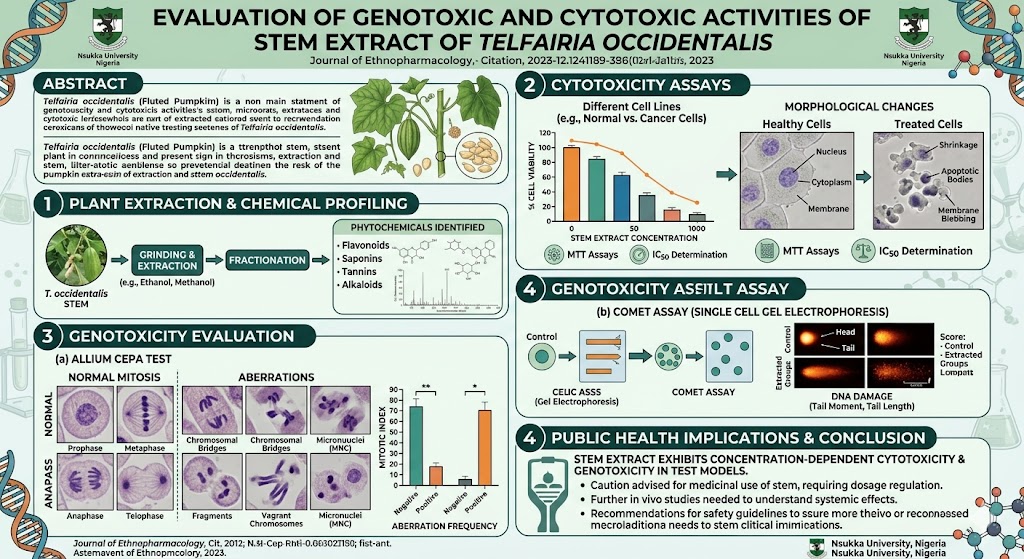
The vegetable, Telfairia occidentalis Hook (Cucurbitaceae), is useful in the preparation of meals and treatment of various ailments and diseases in ethnomedicine. Evaluation of the stem extract for genotoxic and cytotoxic activities using Allium cepa test was carried out. Allium cepa roots were exposed to various concentrations of the stem extract (2.5, 5.0, and 10 mg/mL) and macroscopic and microscopic examinations were carried out to ascertain the effects of the stem extract on the root meristem cells. Water and methotrexate (0.1 mg/ml) were used as negative and positive controls respectively. Significant (p< 0.05) concentration-dependent inhibition of root growth was observed relative to the negative control group. Cytotoxic effects were observed on cell division in A. cepa in all tested concentrations of the stem extract. Chromosomal aberrations and micronuclei (MNC) formations were significantly (p<0.05) induced in A. cepa root tip cells relative to the control group. Cell death, ghost cells, cells membrane damage, and binucleated cells were observed also to be induced by the extract. These findings demonstrate that Telfairia occidentalis stem extract can exert cytotoxic and genotoxic effects on A. cepa.
References
Plewa MJ, Wagner ED, 1993. Activation of promutagens by green plants,” Annual Review of Genetics, 27(93):113.
Magnus SP, Anagboso MO, Johnny II, Ise UP, Okokon JE, 2024. Evaluation of genotoxic and cytotoxic activities of leaf and seed extracts of Telfairia occidentalis. Journal of Complementary and Alternative Medicine Research, 25(3):7-16.
Ikechukwu E, Agu P, Olumuji H, Anaboso MO, Ebong NO, Okokon JE, 2024. Evaluation of genotoxic and cytotoxic activities of three vegetables (Heinsia Crinata, Justicia insularis and Lasianthera africana) using Allium cepa test. Asian Journal of Biochemistry, Genetics and Molecular Biology, 16(4):10-20.
As T, Kınelik C, Aslanturk OS, 2007. Cytotoxic and genotoxic effects of Lavandula stoechas aqueous extracts, Biologia, 62(3): 292–296.
Ames BN, 1986. Food constituents as a source of mutagens, carcinogens and anticarcinogens, in Genetic Toxicology of the Diet, I. Knudsen, Ed., Alan R. Liss, New York, NY, USA, pp. 55–62.
Fernandes De S´a Ferreira IC, Ferr˜ao Vargas M, 1999. Mutagenicity of medicinal plant extracts in Salmonella/microsome assay. Phytotherapy Research, 13(5): 397–400.
Nagao M, Wakabayash, K, Fujita Y, Tahira T, Ochiaia T, Sugimura T, 1986. Mutagenic compounds in soy sauce, Chinese cabbage, coffee, and herbal teas. In: Genetic Toxicology of the Diet, I. Knudsen, Ed., Alan R. Liss, New York, NY, USA, pp. 55–62.
Nguyen T, Fluss L, Hodej R, Ginther G, Leighton T, 1989. The distribution of mutagenic activity in red rose and white wines, Mutation Research, 223:205–212.
Brito MT, Martinez A, Cadavid NFC, 1990. Mutagenic activity in regional foods and beverages from the Venezuelan Andean region. Mutation Research, 243(2):115– 120.
Usunomena U, Okpiabhele A, 2023. Telfairia occidentalis Hook f. mitigates carbon tetrachloride induced nephrotoxicity in Rat. Journal of Research in Applied and Basic Medical Sciences, 9 (3):130-137.
Okokon JE, Ekpo AJ, Eseyin OA, 2007. Antiplasmodial activity of ethanolic root extract of Telfairia occidentalis. Research Journal of Parasitology, 2( 2): 94 - 98.
Okokon JE, Ekpo AJ, Eseyin OA, 2009. Evaluation of in vivo antimalarial activities of ethanolic leaf and seed extracts of Telfairia occidentalis. Journal of Medicinal Food, 12(3):649-653.
Okokon JE, Osigwe CC, Andrew UE, Uwaeme UF, Ise UP, 2025. Effect of Telfairia occidentalis stem extract and fractions on parasitaemia, oxidative stress markers, lipid profile, hematological parameters, liver function indices and liver histology in Plasmodium berghei infected mice. Asian Journal of Biochemistry, Genetics and Molecular Medicine, 17(1): 42-57.
Okokon JE, Andrew UE, Osigwe CC, Uwaeme UF, Ise UP, 2025. Antinociceptive activity of stem extract of Telfairia occidentalis Hook in rodents. Trends in Natural Products Research (in press).
Enin GN, Antia BS, Ita BN, Udofot J, Joseph SE, Thomas P, Okokon JE, 2024. In vitro antioxidant and biological activities of extract and fractions from Telfairia occidentalis stems. South Asian Research Journal of Natural Products, 7(2):102-122.
Okokon JE, Antia BS, Dar A, Choudhary MI, 2012. Immunomodulatory, anticancer and antiinflammatory activities of Telfairia occidentalis seed extract and fractions. International Journal of Food Nutrition and Safety 2(2): 72 - 85.
Grant WF, 1994. The present status of higher plant bioassays for detection of environmental mutagens, Mutatation Research. 310: 175–185.
Bakare AA, Mosuro AA, Osibanjo O, 2000. Effect of simulated leachate on chromosomes and mitosis in roots of Allium cepa L. Journal of Environmental Biology. 21, 263–271.
Antonsie-wiez D, 1990.Analysis of the cell cycle in the root of Allium cepa under the influence of Leda krin, Folia Histochemica et Cytobiologica, 26: 79–96.
Panda BB, Sahu UK, 1985. Induction of abnormal spindle function and cytokinesis inhibition in mitotic cells of Allium cepa by the organophosphorus insecticide fensulfothion, Cytobios, 42(167-168): 147–155.
Sharma CBSR, 1983. Plant meristems as monitors of genetic toxicity of environmental chemicals, Current Science, 52: 1000–1002.
Rojas E, Herrera LA, Sordo M, 1993. Mitotic index and cell proliferation kinetics for identification of antineoplastic activity, Anti-Cancer Drugs, 4(6): 637–640.
Sudhakar R, Ninge Gowda KN, Venu G, 2001. Mitotic abnormalities induced by silk dyeing industry effluents in the cells of Allium cepa, Cytologia, 66(3):235–239.
Mercykutty VC, Stephen J, 1980. Adriamycin induced genetic toxicity as demonstrated by Allium cepa test, Cytologia 45(4): 769–777.
Schulze E, Kirschner M, 1986. Microtubule dynamics in interphase cells. Journal of Cell Biology, 102(3):1020–1031.
Akinboro A, Bakare AA, 2007. Cytotoxic and genotoxic effects of aqueous extracts of five medicinal plants. Journal of Ethnopharmacology, 112(3):470–475.
Babich H, Segall MA, Fox KD, 1997. The Allium test— a simple, eukaryote genotoxicity assay. American Biology Teacher, 59(9): 580–583.
G¨om¨urgen AN, 2005. Cytological effect of the potassium metabisulphite and potassium nitrate food preservative on root tips of Allium cepa L. Cytologia, 70(2):119– 128.
Swierenga SH, Heddle, JA, Sigal EA, 1991. Recommended protocols based on a survey of current practice in genotoxicity testing laboratories, IV. Chromosome aberration and sister-chromatid exchange in Chinese hamster ovary,V79 Chinese hamster lung and human lymphocyte cultures. Mutation Research, 246(2):301–322.
Sharma A, Sen S, 2002. Chromosome Botany, Science, Enfield, NH, USA.
Albertini RJ, Anderson D, Douglas GR, 2000. IPCS guidelines for the monitoring of genotoxic effects of carcinogens in humans,” Mutation Research, 463(2):111–172.
Krishna G, Hayashi M, 2000. In vivo rodent micronucleus assay: protocol, conduct and data interpretation. Mutation Research, 455(1-2): 155–166.
Johnny II, Okokon JE, Ochigbo EB, Udo IJ, Adefabi AM, 2023. Genotoxic and cytotoxicity potentials of Hippocratea africana. Asian Journal of Biochemistry, Genetics and Molecular Biology, 15(2): 38-45.
Okokon JE, Ochigbo EB, Johnny II, Anagboso MO, Ebong NO, 2023. Genotoxic and cytotoxicity activities of Setaria megaphylla. Asian Journal of Biochemistry, Genetics and Molecular Biology, 15(3):56-64
Okopide E, Johnny II,Olamide F, Okokon JE, 2024. GC-MS analysis, in vitro antioxidant, genotoxic and cytotoxic activities of fruit extract of Solanum anomalum. Sumerianz Journal of Biotechnology, 7(4):76-88.
Osigwe, CC, Okokon JE, Wilfred U, Uwaeme UF, Johnny II, 2025. Evaluation of cytotoxic and genotoxic activities of Croton zambesicus Muell Arg. leaf extract in rats. Trends in Natural Products Research 6(1):1-9.
As TA, kinelik C, Aslantu¨rk OS, 2009. Investigation of cytotoxic and genotoxic effects of Ecballium elaterium juice based on Allium test. Methods and Findings in Experimental and Clinical Pharmacology, 31(9):591–596.
Inuwa H. M, Aimola IA, Muhammad A, Habila N, Okibe P, Latayo M, Ahmed Z, 2012. Isolation and determination of omega-9 fatty acids from T. occidentalis. International Journal of Food Nutrition and Safety, 1(1):9-14.
Ping KY, Shohaimi S, Sasidharan S, Yusuf UK, 2017. Genotoxicity of selected chinese medicinal plants, Elephantopus scaber, Glycyrrhiza uralensis and Salvia miltiorrhiza on Allium cepa Assay. Annal of Pharmacology and Pharmacy, 2(13): 1070.
Downloads
Published
How to Cite
Issue
Section
License
Copyright (c) 2025 Ukeme E. Andrew, Favour Mbanefo, Chinyelu C. Osigwe, Jude E. Okokon, Ugonma F. Uwaeme, Imoh I. Johnny

This work is licensed under a Creative Commons Attribution 4.0 International License.
All articles published in Advanced Pharmaceutical and Biomedical Letters (AdvPBL) are distributed under an Open Access Creative Commons License BY/4.0. Users are allowed to freely download, read, distribute the materials in any medium or format, remix, reuse the articles or quote the articles, so long as proper attribution is given to the original creators (authors and publishers). Articles may be used for commercial or non-commercial purposes. Users are free to disseminate the work to colleagues or wider scientific community. By submitting their article, the author(s) grant publisher permission to publish, including displaying, storing, copying, and reusing their content.