Antiulcer Activity of Stem Extract of Telfairia Occidentalis in Rodents
DOI:
https://doi.org/10.59493/advpbl/2025.1.2Keywords:
Telfairia occidentalis; antiulcerogenic; gastrointestinal disorders; ulcerAbstract
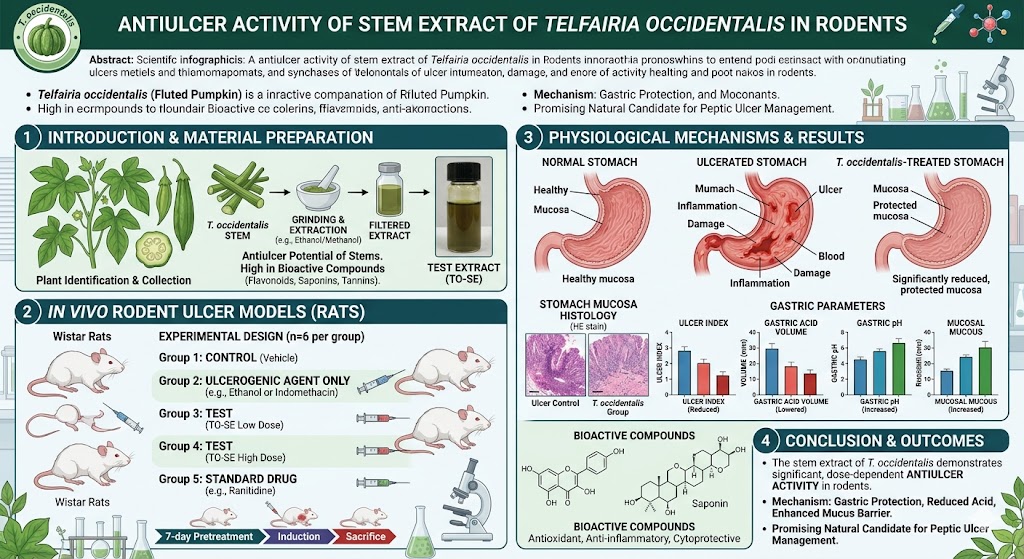
The vegetable, Telfairia occidentalis Hook (Cucurbitaceae), is useful in Ibibio traditional medicine system for the treatment of various types of diseases such as malaria and gastrointestinal disorders. Antiulcerogenic activity of the stem extract was evaluated against ulcers experimentally-induced in rats. Three doses (200, 400 and 600 mg/kg) of the stem extract of Telfairia occidentalis were used to investigate the antiulcer activity in three experimental models; indomethacin, ethanol and histamine-induced ulcers. The animals weighing 130-155 g were fasted overnight before being randomized into different experimental groups and treated with extract and ulcerogens. In each model, the animals were sacrificed after the required period of time and their stomachs removed and examined for ulcerations. Ulcers scores were awarded and preventive ratio calculated accordingly. The results showed that the stem extract (200-600 mg/kg) exerted dose-dependent and significant (p<0.05-0.001) antiulcer potential against ulcers induced by indomethacin, ethanol and histamine. These findings show that the stem extract of Telfairia occidentalis exhibited antiulcer property which is traceable to the actions of the phytoconstituents and thus a useful remedy for ulcers.
References
Magnus SP, Anagboso MO, Johnny II, Ise UP, Okokon JE, 2024. Evaluation of genotoxic and cytotoxic activities of leaf and seed extracts of Telfairia occidentalis. Journal of Complementary and Alternative Medicine Research, 25(3):7-16.
Usunomena U, Okpiabhele A, 2023. Telfairia occidentalis Hook f. mitigates Carbon Tetrachloride induced Nephrotoxicity in Rat. Journal of Research in Applied and Basic Medical Sciences, 9 (3):130-137.
Bassey IO, Okon IA, Beshel JA, Umoren EB, Owu DU, 2022. Aqueous Leaves Extract of Telfairia occidentalis (Fluted Pumpkin) Protects Against Gastric Ulcer and Inhibits Intestinal Motility in Wistar Rats. Journal of Applied Sciences, 22: 92-99.
Adisa W, 2020. Attenuating effect of Telfairia occidentalis on oxidative stress in indomethacin induced gastric ulcer in male rats. Nigeria Journal of Physiology, 35(2):195- 201.
Okokon JE, Ekpo AJ, Eseyin OA, 2007. Antiplasmodial activity of ethanolic root extract of Telfairia occidentalis. Research Journal of Parasitology, 2( 2): 94 - 98.
Okokon JE, Ekpo AJ, Eseyin OA, 2009. Evaluation of in vivo antimalarial activities of ethanolic leaf and seed extracts of Telfairia occidentalis. Journal of Medicinal Food, 12(3):649-653.
Okokon JE, Osigwe CC, Andrew UE, Uwaeme UF, Udobang JA, Ise UP, 2025. Effect of Telfairia occidentalis stem extract on parasitaemia, oxidative stress markers, lipid profile, haematological parameters, liver function indices and liver histology in Pasmodium berghei infected mice. Asian Journal of Biochemistry, Genetics and Molecular Biology, 17(1), 42-57.
Okokon JE, Andrew UE, Osigwe CC, Uwaeme UF, 2025. Antinociceptive activity of stem extract of Telfairia occidentalis in rodents. Trends in Natural Products Research, 6(1): 35-44.
Enin GN, Antia BS, Ita BN, Udofot J, Joseph SE, Thomas P, Okokon JE, 2024. In vitro antioxidant and biological activities of extract and fractions from Telfairia occidentalis stems. South Asian Research Journal of Natural Products,7(2):102-122.
Oluwole ES, Folade AO, Ogundipe OO, 2003. Antiinflammatory effect of some common Nigerian vegetables. Nigerian Journal of Physiological Sciences,18:35 -38.
Okokon JE, Antia BS, Dar A, Choudhary MI, 2012. Immunomodulatory, anticancer and antiinflammatory activities of Telfairia occidentalis seed extract and fractions. International Journal of Food Nutrition and Safety, 2(2): 72 - 85.
Lorke D, 1983. A new approach to practical acute toxicity testing. Achieves of Toxicology, 54:275-286.
Edem UA, Okokon JE, Bassey AL, Iyanyi UL, 2023. Antiulcer activity of leaf extract of Saccharum officinarum. Nigerian Journal of Pharmaceutical and Applied Sciences Research, 12(2):22-27.
Okokon JE, Obot J, Amazu LU, 2018. Antiulcerogenic activity of husk extract of Zea mays. African Journal of Pharmacology and Therapeutics, 7(2): 41-45.
Bhandare P, Diniz-D’Souza R, Mainker A, Dhume V, 1990. Protective effect of propranolol on ethanol-induced gastric lesions in mice. European Journal of Pharmacology, 191(2): 167-172.
Kaan SK, Cho CH, 1996. A study of the antiulcer mechanisms of propranolol in rats. Inflammation Research, 45(8): 370-375.
Bhargava KP, Gupta MB, Tangri KK, 1973. Mechanism of ulcerogenic activity of indomethacin and oxyphenbutazone. European Journal of Pharmacology, 22:191 – 195.
Evbuonwa MT, Bolarinwa AF, 1990. Effect of diet on indomethacin-induced peptic ulceration in pregnant rats. Nigerian. Journal of Physiology Science, 6:189 – 191.
Nwafor PA, Effraim KD, Jacks TW, 1996. Gastroprotective effects of aqueous extracts of Khaya senegalensis bark on indomethacin – induced ulceration in rats. West African Journal Pharmacology and Drug Research, 12:46 – 50.
Rainsford KD, 1987. The effects of 5- lipoxygenase inhibitors and leukotriene antagonists on the development of gastric lesions induced by nonsteroidal anti-inflammatory drugs in mice. Agents and Action, 21:316 – 319.
Hayllar J, Bjarnason I, 1995. NSAIDS, COX-2 inhibitor and the gut. Lancet, 346(8974):521 - 522.
Hiruma-Lima CA, Calvo TR, Rodriguez CM, Andrade FDP, Vilegas W, Brito ARM, 2006. Antiulcerogenic activity of Alchornea castaneaefolia effects on somatostatin, gastrin and prostaglandin. Journal of Ethnopharmacology, 104: 215 – 224.
Salim AS, 1990. Removing oxygen derived free radicals stimulates healing of ethanol- induced erosive gastritis in the rats. Digestion, 47: 24 – 28.
Pihan G, Regillo C, Szabo S, 1987. Free radicals and lipid peroxidation in ethanol or aspirin – induced gastric mucosa injury. Digestive Diseases and Sciences, 32: 1395 – 1401.
Whittle BJR, Oren-Wolman N, Guth PH,1985. Gastric vasoconstrictor actions of leukotriene C4 and PGF2α and thromboxane mimetic (U-4669) on rats submucosal microcirculation in vivo. American Journal of Physiology, 248: G580 – G586.
Cho CH, Pfeiffer CJ, 1981. Gastrointestinal ulceration in the guinea pigs in response to dimaprit, histamine and H1 and H2 blocking agents. Digestive Disease Science, 26:306 – 311.
Di Carlo G, Mascolo N, Izzo A A, Capasso F, 1999. Flavonoids: old and new aspects of a class of a natural therapeutic drug. Life Science, 64: 337 – 353.
Zayachkivska OS, Konturek SJ, Drozdowicz D, Konturek PC, Brzozowsk T, Ghegotsky MR, 2005. Gastroprotective effects of flavonoids in plants extracts. Journal of Physiology and Pharmacology, 56: 216 - 231.
Borrelli F, Izzo AA, 2000. The plant kingdom as source of anti ulcer remedies. Phytotherapy Research, 14: 581 – 591.
Agwu CN, Okunji CO, 1986. Gastrointestinal studies of Pyrenacantha staudtii leaf extracts. Journal of Ethnopharmacology, 15: 45 – 55.
Lewis DA, 1991. Hanson D. Anti-ulcer drugs of plants origin. Progressive Medicine Chemistry, 28:208 – 210.
Kohno Y, Egawa Y, Itoh S, Nagaoka S, Takahashi M, Mukai K, 1995. Kinetic study of quenching reaction of singlet oxygen and scavenging reaction of free radical by squalene in n-butanol. Biochimica et Biophysica Acta, 1256:52–56.
Ponnamma SU, Manjunath K, 2012. GC-MS analysis of phytocomponents in the methanolic extract of Justicia wyaadensis (NEES) T. Anders. International Journal of Pharmacy and Biological Science, 3:570-576.
Khan SL, Siddiqui FA, 2020. Beta-Sitosterol: As immunostimulant, antioxidant and inhibitor of SARS-CoV-2 spike glycoprotein. Archive of Pharmacology and Therapeutic Journal, 2(1):12-16.
Downloads
Published
How to Cite
Issue
Section
License
Copyright (c) 2025 Jude E. Okokon, Ukeme E. Andrew, Chinyelu C. Osigwe, Ugonma F. Uwaeme

This work is licensed under a Creative Commons Attribution 4.0 International License.
All articles published in Advanced Pharmaceutical and Biomedical Letters (AdvPBL) are distributed under an Open Access Creative Commons License BY/4.0. Users are allowed to freely download, read, distribute the materials in any medium or format, remix, reuse the articles or quote the articles, so long as proper attribution is given to the original creators (authors and publishers). Articles may be used for commercial or non-commercial purposes. Users are free to disseminate the work to colleagues or wider scientific community. By submitting their article, the author(s) grant publisher permission to publish, including displaying, storing, copying, and reusing their content.