Molecular Docking and ADMET Prediction of Piper guineense and Telfairia occidentalis Phytoconstituents Targeting DPP-4 and PPARγ Receptors
DOI:
https://doi.org/10.59493/advpbl/2026.1.11Abstract
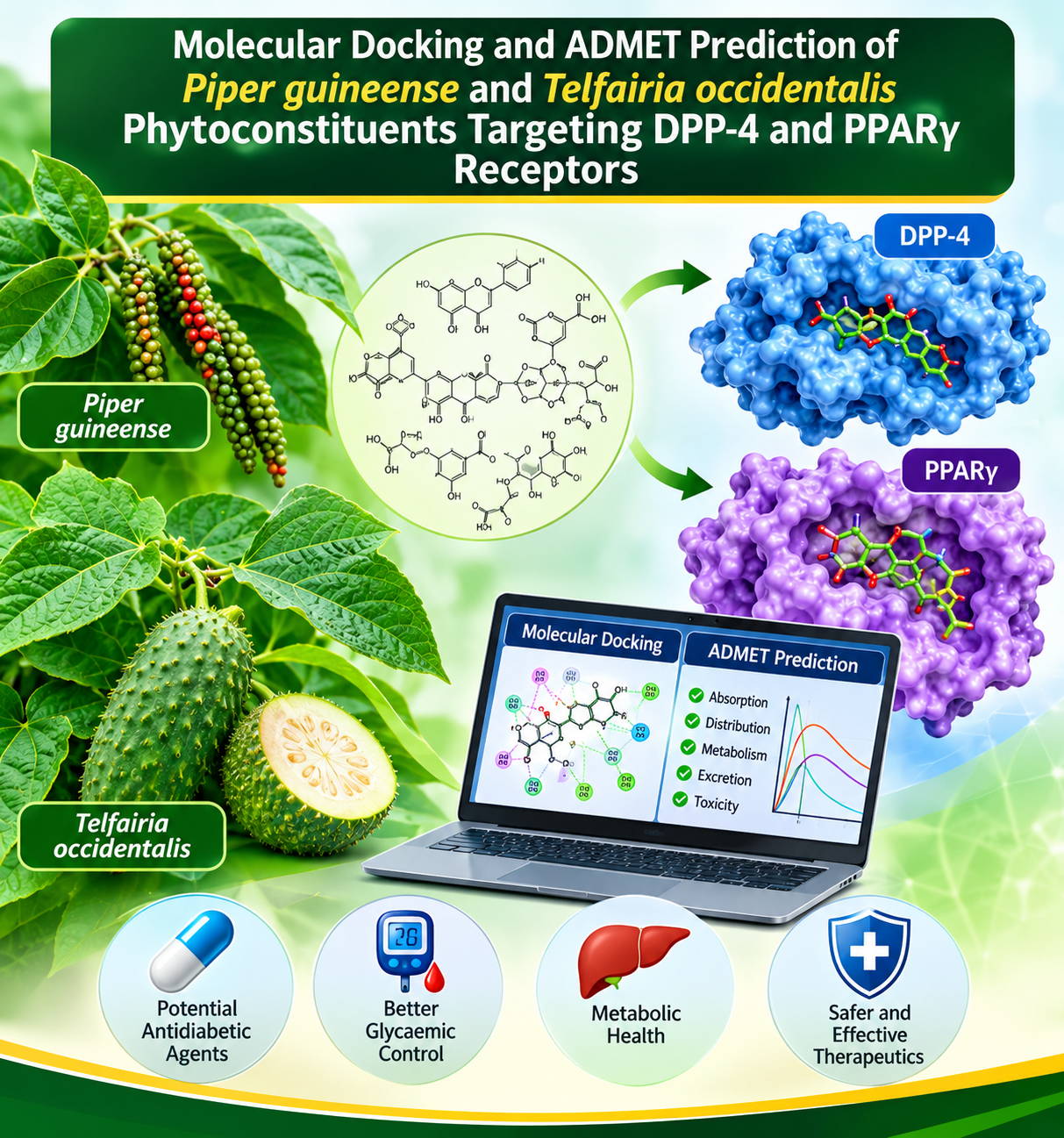
Diabetes mellitus remains a leading non-communicable metabolic disorder worldwide, driving continued interest in affordable, effective, and safe therapeutic agents from indigenous medicinal plants. This study aims to evaluate the antidiabetic potential of phytoconstituents from Piper guineense (uziza) and Telfairia occidentalis (fluted pumpkin) targeting dipeptidyl peptidase-4 (DPP-4, PDB ID: 4FFW) and peroxisome proliferator-activated receptor gamma (PPARγ, PDB ID: 5Y2O), two validated antidiabetic drug targets, using in silico methods. Phytoconstituents from both plants were retrieved from PubChem and docked against DPP-4 and PPARγ crystal structures using PyRx, with sitagliptin and pioglitazone as reference ligands. Receptor-ligand interactions were analyzed with BIOVIA Discovery Studio Visualizer 2020. SwissADME and ADMETLab were used to analyze the pharmacokinetic and toxicity profiles of ligands with binding affinity comparable to the reference ligands. Of the 125 P. guineense and 77 T. occidentalis phytoconstituents docked, 14 and 8, respectively, showed binding affinities equal or superior to the standards. Notably, gamma-tocopherol and a related dihydrochromenol derivative, both from P. guineense, showed binding affinities for DPP-4 (-9.9 kcal/mol) and PPARγ (-10.7 kcal/mol) exceeding sitagliptin (-8.4 kcal/mol) and pioglitazone (-8.8 kcal/mol). Most ligands satisfied Lipinski's Rule of Five with zero violations, though several tocopherol-related compounds showed high lipophilicity. Toxicity predictions were mixed, with the P. guineense tocopherol-related compounds showing the most favorable safety profiles. Phytoconstituents of both P. guineense and T. occidentalis show promising antidiabetic potential targeting DPP-4 and PPARγ, with P. guineense tocopherol-related compounds emerging as the leading candidates, warranting further in vitro and in vivo validation as candidate antidiabetic leads.
References
Goyal R, Singhal M, Jialal I, 2023. Type 2 diabetes. In: StatPearls. Treasure Island (FL): StatPearls Publishing. [Accessed 26th September, 2026]. Available: https://www.ncbi.nlm.nih.gov/books/NBK513253/
Kulkarni A, Thool AR, Daigavane S, 2024. Understanding the clinical relationship between diabetic retinopathy, nephropathy, and neuropathy: A comprehensive review. Cureus, 16(3): e56674. https://doi.org/10.7759/cureus.56674
Genitsaridi I, Salpea P, Salim A, Sajjadi SF, Tomic D, James S, Thirunavukkarasu S, Issaka A, Chen L, Basit A, Luk AOY, Ma RCW, Mbanya JC, Ramachandran A, Wild SH, Duncan BB, Boyko EJ, Magliano DJ, 2025. 11th edition of the IDF Diabetes Atlas: global, regional, and national diabetes prevalence estimates for 2024 and projections for 2050. The Lancet Diabetes & Endocrinology. https://doi.org/10.1016/S2213-8587(25)00299-2
Makrilakis K, 2019. The role of DPP-4 inhibitors in the treatment algorithm of type 2 diabetes mellitus: When to select, what to expect. International Journal of Environmental Research and Public Health, 16(15): 2720. https://doi.org/10.3390/ijerph16152720
Kasina SVSK, Baradhi KM, 2023. Dipeptidyl peptidase IV (DPP IV) inhibitors. In: StatPearls. Treasure Island (FL): StatPearls Publishing. [Accessed 26th September, 2026]. Available: https://www.ncbi.nlm.nih.gov/books/NBK542331/
Basak S, Murmu A, Matore BW, Roy PP, Singh J, 2024. Thiazolidinedione an auspicious scaffold as PPAR-γ agonist: its possible mechanism to manoeuvre against insulin resistant diabetes mellitus. European Journal of Medicinal Chemistry Reports, 11: 100160. https://doi.org/10.1016/j.ejmcr.2024.100160
Eggleton JS, Jialal I, 2023. Thiazolidinediones. In: StatPearls. Treasure Island (FL): StatPearls Publishing. [Accessed 26th September, 2026]. Available: https://www.ncbi.nlm.nih.gov/books/NBK551656/
Alagbe OA, Alagbe GO, Adekunle EA, Ayodele OO, Olorode EM, Oyediran RI, Oloyede EO, Oluwaloni FO, Oyeleye AO, 2021. Ethnomedicinal uses and therapeutic activities of Piper guineense: A review. Journal of Applied Sciences and Environmental Management, 25(6): 927-937. https://doi.org/10.4314/jasem.v25i6.6
Ojimelukwe PC, 2022. Telfairia occidentalis: A blood booster, an antioxidant and an antihyperglycaemic agent. International Journal of Food Science and Nutrition, 7(3): 1-9. Available: https://www.foodsciencejournal.com/assets/archives/2022/vol7issue3/7-3-13-398.pdf
Ugwu PN, Eze FI, Chukwube VO, Mgbeokwere CE, Ezenwanne DO, Ezea CC, Okonta EO, Odo EU, 2025. Pharmacognostic, phytochemical, antioxidant and toxicological properties of aqueous extract of Telfairia occidentalis Hook. F. leaves. Tropical Journal of Pharmaceutical Research, 24(4): 529-537. https://doi.org/10.4314/tjpr.v24i4.10
Dar AM, Mir S, 2017. Molecular docking: Approaches, types, applications, and basic challenges. Journal of Analytical and Bioanalytical Techniques, 8(2): 8-10. https://doi.org/10.4172/2155-9872.1000356
Asiamah I, Obiri SA, Tamekloe W, Armah FA, Borquaye LS, 2023. Applications of molecular docking in natural products-based drug discovery. Scientific African, 20: e01593. https://doi.org/10.1016/j.sciaf.2023.e01593
Kommalapati HS, Pilli P, Golla VM, Bhatt N, Samanthula G, 2023. In silico tools to thaw the complexity of the data: Revolutionizing drug research in drug metabolism, pharmacokinetics and toxicity prediction. Current Drug Metabolism, 24(11): 735-755. https://doi.org/10.2174/0113892002270798231201111422
Kim S, Chen J, Cheng T, Gindulyte A, He J, He S, Li Q, Shoemaker BA, Thiessen PA, Yu B, Zaslavsky L, Zhang J, Bolton EE, 2023. PubChem 2023 update. Nucleic Acids Research, 51(D1): D1373-D1380. https://doi.org/10.1093/nar/gkac956
Dallakyan S, Olson AJ, 2015. Small-molecule library screening by docking with PyRx. Methods in Molecular Biology, 1263: 243-250. https://doi.org/10.1007/978-1-4939-2269-7_19
Trott O, Olson AJ, 2010. AutoDock Vina: Improving the speed and accuracy of docking with a new scoring function, efficient optimization, and multithreading. Journal of Computational Chemistry, 31(2): 455-461. https://doi.org/10.1002/jcc.21334
O'Boyle NM, Banck M, James CA, Morley C, Vandermeersch T, Hutchison GR, 2011. Open Babel: An open chemical toolbox. Journal of Cheminformatics, 3: 33. https://doi.org/10.1186/1758-2946-3-33
Daina A, Michielin O, Zoete V, 2017. SwissADME: A free web tool to evaluate pharmacokinetics, drug-likeness, and medicinal chemistry friendliness of small molecules. Scientific Reports, 7: 42717. https://doi.org/10.1038/srep42717
Xiong G, Wu Z, Yi J, Fu L, Yang Z, Hsieh C, Yin M, Zeng X, Wu C, Lu A, Chen X, Hou T, Cao D, 2021. ADMETlab 2.0: An integrated online platform for accurate and comprehensive predictions of ADMET properties. Nucleic Acids Research, 49(W1): W5-W14. https://doi.org/10.1093/nar/gkab255
Berman HM, Westbrook J, Feng Z, Gilliland G, Bhat TN, Weissig H, Shindyalov IN, Bourne PE, 2000. The Protein Data Bank. Nucleic Acids Research, 28(1): 235-242. https://doi.org/10.1093/nar/28.1.235
Burley SK, Bhikadiya C, Bi C, Bittrich S, Chen L, Crichlow GV, Christie CH, Dalenberg K, Di Costanzo L, Duarte JM, Dutta S, Feng Z, Ganesan S, Goodsell DS, Ghosh S, Green RK, Guranović V, Guzenko D, Hudson BP, Lawson CL, Liang Y, Lowe R, Namkoong H, Peisach E, Persikova I, Randle C, Rose A, Rose Y, Sali A, Segura J, Sekharan M, Shao C, Tao YP, Voigt M, Westbrook JD, Young J, Zardecki C, Zhuravleva M, 2021. RCSB Protein Data Bank: powerful new tools for exploring 3D structures of biological macromolecules for basic and applied research and education in fundamental biology, biomedicine, biotechnology, bioengineering and energy sciences. Nucleic Acids Research, 49(D1): D437-D451. https://doi.org/10.1093/nar/gkaa1038
Eseyin OA, Zubaid M, Rathore HA, Aigbe F, Afzal S, Ahmad A, Lazhari M, Akhtar S, 2018. GC-MS and HPLC profiles of phenolic fractions of the leaf of Telfairia occidentalis. Pakistan Journal of Pharmaceutical Sciences, 31(1): 45-50.
Desire TC, Itoro EW, Itohowo OA, Ekemini TD, 2022. Antioxidant activity and identification of bioactive compounds in Telfairia occidentalis leaves using GC-MS analysis. World Journal of Advanced Research and Reviews, 16(3): 775-788. https://doi.org/10.30574/wjarr.2022.16.3.1291
Ogbeide UM, Owowenu KO, 2026. In silico evaluation of the antidiarrhoeal potential of phytoconstituents from Vernonia amygdalina, Ocimum gratissimum and Piper guineense. Nigerian Journal of Pharmaceutical and Applied Science Research, 15(2): 7-22. https://doi.org/10.60787/nijophasr-v15-i2-649
Ferreira LG, dos Santos RN, Oliva G, Andricopulo AD, 2015. Molecular docking and structure-based drug design strategies. Molecules, 20(7): 13384-13421. https://doi.org/10.3390/molecules200713384
Wang G, Zhu G, 2016. Molecular docking for drug discovery and development: a widely used approach but far from perfect. Future Medicinal Chemistry, 8(14): 1707-1710. https://doi.org/10.4155/fmc-2016-0143
Baranowska J, Kiss A, Szeleszczuk Ł, 2026. Molecular docking of natural compounds as DPP-4 inhibitors in type 2 diabetes: A comprehensive review. Pharmaceutics, 18(6): 741. https://doi.org/10.3390/pharmaceutics18060741
Hori H, Takayanagi T, Kamada Y, Shimoyoshi S, Ono Y, Kitagawa Y, Shibata H, Nagao M, Fujii W, Sakakibara Y, 2011. Genotoxicity evaluation of sesamin and episesamin. Mutation Research/Genetic Toxicology and Environmental Mutagenesis, 719(1-2): 21-28. https://doi.org/10.1016/j.mrgentox.2010.10.001
Medola JF, Cintra VP, Silva EPE, Royo VA, Silva R, Saraiva J, Albuquerque S, Bastos JK, Tavares DC, 2007. (-)-Hinokinin causes antigenotoxicity but not genotoxicity in peripheral blood of Wistar rats. Food and Chemical Toxicology, 45(4): 638-642. https://doi.org/10.1016/j.fct.2006.10.012
Hossain A, Rahman ME, Faruqe MO, Saif A, Suhi S, Zaman R, Hirad AH, Matin MN, Rabbee MF, Baek KH, 2024. Characterization of plant-derived natural inhibitors of dipeptidyl peptidase-4 as potential antidiabetic agents: A computational study. Pharmaceutics, 16(4): 483. https://doi.org/10.3390/pharmaceutics16040483
Sajal H, Patil SM, Raj R, Shbeer AM, Ageel M, Ramu R, 2022. Computer-aided screening of phytoconstituents from Ocimum tenuiflorum against diabetes mellitus targeting DPP4 inhibition: A combination of molecular docking, molecular dynamics, and pharmacokinetics approaches. Molecules, 27(16): 5133. https://doi.org/10.3390/molecules27165133
Afolabi OB, Olasehinde OR, Olanipon DG, Mabayoje SO, Familua OM, Jaiyesimi KF, Agboola EK, Idowu TO, Obafemi OT, Olaoye OA, Oloyede OI, 2023. Antioxidant evaluation and computational prediction of prospective drug-like compounds from polyphenolic-rich extract of Hibiscus cannabinus L. seed as antidiabetic and neuroprotective targets: assessment through in vitro and in silico studies. BMC Complementary Medicine and Therapies, 23(1): 203. https://doi.org/10.1186/s12906-023-04023-7
Campbell SE, Stone WL, Whaley SG, Qui M, Krishnan K, 2003. Gamma tocopherol upregulates peroxisome proliferator activated receptor (PPAR) gamma expression in SW 480 human colon cancer cell lines. BMC Cancer, 3: 25. https://doi.org/10.1186/1471-2407-3-25
Sulaimon LA, Anise EO, Obuotor EM, Samuel TA, Moshood AI, Olajide M, Fatoke T, 2020. In vitro antidiabetic potentials, antioxidant activities and phytochemical profile of African black pepper (Piper guineense). Clinical Phytoscience, 6: 90. https://doi.org/10.1186/s40816-020-00236-2
Downloads
Published
How to Cite
Issue
Section
License
Copyright (c) 2026 Kluvet O. Owowenu, Uyi M. Ogbeide

This work is licensed under a Creative Commons Attribution 4.0 International License.
All articles published in Advanced Pharmaceutical and Biomedical Letters (AdvPBL) are distributed under an Open Access Creative Commons License BY/4.0. Users are allowed to freely download, read, distribute the materials in any medium or format, remix, reuse the articles or quote the articles, so long as proper attribution is given to the original creators (authors and publishers). Articles may be used for commercial or non-commercial purposes. Users are free to disseminate the work to colleagues or wider scientific community. By submitting their article, the author(s) grant publisher permission to publish, including displaying, storing, copying, and reusing their content.