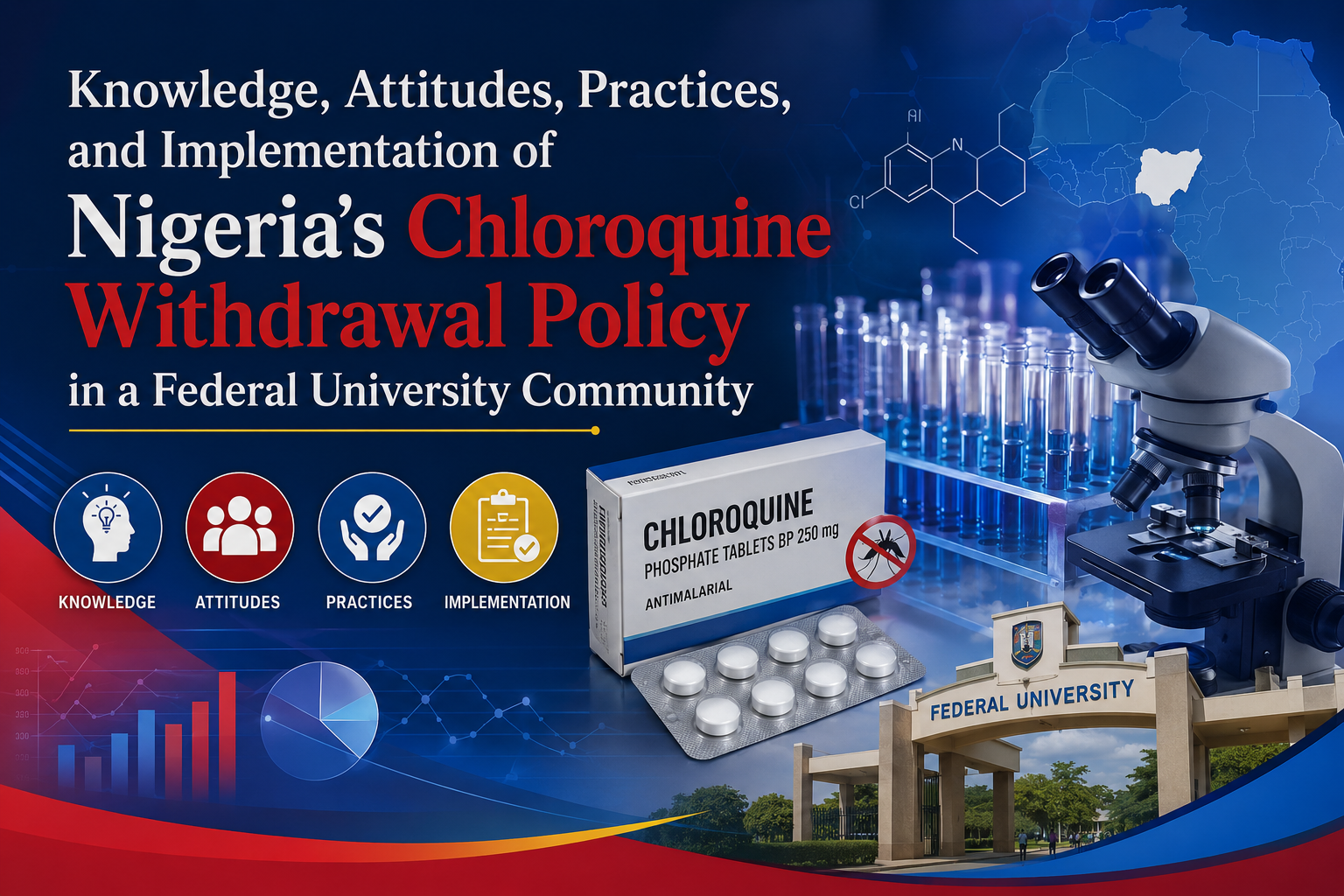
Knowledge, Attitudes, Practices, and Implementation of Nigeria’s Chloroquine Withdrawal Policy in a Federal University Community
DOI:
https://doi.org/10.59493/advpbl/2026.1.6Keywords:
Artemisinin-based combination therapies, chloroquine , drug resistance, malaria, Nigeria, policy complianceAbstract
Chloroquine was withdrawn from first-line malaria treatment in Nigeria because of widespread Plasmodium falciparum resistance and was replaced by artemisinin-based combination therapies (ACTs). Nevertheless, continued access to and use of chloroquine may weaken implementation of the withdrawal policy. This study assessed implementation of the policy by examining knowledge, attitudes, practices, barriers, and predictors of compliant malaria treatment. A convergent mixed-methods cross-sectional survey was conducted among 456 students and staff of David Umahi Federal University of Health Sciences, Ebonyi State, Nigeria. Quantitative data were analysed in Stata version 17 using descriptive statistics, Pearson’s chi-square test, and multivariable logistic regression, with statistical significance set at p < 0.05. Open-ended responses were analysed thematically. Policy implementation was incomplete: 44.1% of respondents had low compliance, 47.1% moderate compliance, and 8.8% high compliance. Occupation was associated with knowledge (p < 0.001), while attitude was associated with treatment practice (p < 0.001). Higher knowledge predicted positive attitudes (AOR = 1.74, 95% CI: 1.56–1.94) and compliant practices (AOR = 1.18, 95% CI: 1.08–1.29). Major barriers were inadequate public awareness, continued chloroquine availability, weak enforcement, and limited affordability of ACTs. Nigeria’s chloroquine withdrawal policy remains only partially implemented in the study setting. Coordinated public education, regulatory enforcement, affordable access to ACTs, and training of healthcare providers and medicine vendors are required to improve compliance.
References
Jagannathan P, Kakuru A, 2022. Malaria in 2022: increasing challenges, cautious optimism. Nature Communications, 13: 2678. https://doi.org/10.1038/s41467-022-30133-w
Ikegbunam MN, Uba C, Flügge J, Abone H, Ezeagwuna D, Ushie S, 2022. Malaria surveillance amongst pregnant women attending antenatal care in private hospitals in Onitsha metropolis, South Eastern Nigeria. Malaria World Journal, 13 (2): 1-9. https://doi.org/10.5281/zenodo.8204413
Nwele DE, Onyali IO, Iwueze MO, Elom MO, Uguru OES, 2022. Malaria endemicity in the rural communities of Ebonyi State, Nigeria. Korean Journal of Parasitology, 60 (3): 173-179. https://pmc.ncbi.nlm.nih.gov/articles/PMC9256290/.
WHO, 2018. World malaria report 2018. World Health Organization: Geneva.
https://www.who.int/publications/i/item/9789241565653.
Monjol BE, Useh MF, 2017. Detection of Plasmodium falciparum chloroquine resistance transporter (PfCRT) mutant gene amongst malaria-infected pregnant women in Calabar, Nigeria. Annals of Parasitology, 63 (4): 323-330. https://pubmed.ncbi.nlm.nih.gov/29419995/
Hemming-Schroeder E, Umukoro E, Lo E, Fung B, Tomás-Domingo P, Zhou G, 2018. Impacts of antimalarial drugs on Plasmodium falciparum drug resistance markers, Western Kenya, 2003-2015. American Journal of Tropical Medicine and Hygiene, 98 (3): 692-699. https://doi.org/10.4269/ajtmh.17-0763
Alareqi LMQ, Mahdy MAK, Lau YL, Fong MY, Abdul-Ghani R, Mahmud R, 2016. Molecular markers associated with resistance to commonly used antimalarial drugs among Plasmodium falciparum isolates from a malaria-endemic area in Taiz Governorate, Yemen, during the transmission season. Acta Tropica, 162: 174-179. https://doi.org/10.1016/j.actatropica.2016.06.016
Simon-Oke IA, Obimakinde ET, Afolabi OJ, 2018. Prevalence and distribution of malaria, Pfcrt and Pfmdr1 genes in patients attending FUT Health Centre, Akure, Nigeria. Beni-Suef University Journal of Basic and Applied Sciences, 7 (1): 98-103. https://doi.org/10.1016/j.bjbas.2017.07.009
Mekonnen SK, Aseffa A, Berhe N, Teklehaymanot T, Clouse RM, Gebru T, 2014. Return of chloroquine-sensitive Plasmodium falciparum parasites and emergence of chloroquine-resistant Plasmodium vivax in Ethiopia. Malaria Journal, 13: 244. https://doi.org/10.1186/1475-2875-13-244
Njiro BJ, Mutagonda RF, Chamani AT, Mwakyandile T, Sabas D, Bwire GM, 2022. Molecular surveillance of chloroquine-resistant Plasmodium falciparum in sub-Saharan African countries after withdrawal of chloroquine for treatment of uncomplicated malaria: a systematic review. Journal of Infection and Public Health, 15 (5): 550-557. https://doi.org/10.1016/j.jiph.2022.03.015
Dagnogo O, Ako AB, Ouattara L, Dago ND, Coulibaly DN, Touré AO, 2018. Towards a re-emergence of chloroquine sensitivity in Côte d’Ivoire? Malaria Journal, 17: 413. https://doi.org/10.1186/s12936-018-2551-7
Ocan M, Akena D, Nsobya S, Kamya MR, Senono R, Kinengyere AA, 2018. Prevalence of chloroquine resistance alleles among Plasmodium falciparum parasites in countries affected by malaria disease since change of treatment policy: a systematic review protocol. Systematic Reviews, 7: 108. https://doi.org/10.1186/s13643-018-0780-z
Ikegbunam MN, Eze DU, Ezissi M, Oli AN, Ikemefuna U, 2025. Over fifteen years of chloroquine withdrawal in Nigeria: a qualitative investigation into the execution of this policy by healthcare providers and amongst patients in a rural community. Open Research Africa, 7: 9. https://doi.org/10.12688/openresafrica.15204.2
Beyeler N, Liu J, Sieverding M, 2015. A systematic review of the role of proprietary and patent medicine vendors in healthcare provision in Nigeria. PLOS ONE, 10 (1): e0117165. https://doi.org/10.1371/journal.pone.0117165
Oyeyemi A, Ogunnowo B, Odukoya O, 2015. Response of patent medicine vendors in rural areas of Lagos State, Nigeria, to antimalarial policy change. African Health Sciences, 15 (2): 420-428. https://doi.org/10.4314/ahs.v15i2.15
Oladepo O, Brieger W, Adeoye B, Lawal B, Peters DH, 2011. Awareness of anti-malarial policy and malaria treatment practices of patent medicine vendors in three Nigerian states. African Journal of Medicine and Medical Sciences, 40 (4): 345-352.
European Union Agency for Asylum, 2021. Ebonyi. In: Country guidance: Nigeria. European Union Agency for Asylum: Valletta.
Cochran WG, 1977. Sampling techniques, 3rd ed., John Wiley & Sons: New York.
WHO, 2025. WHO guidelines for malaria, 13 August 2025. World Health Organization: Geneva. https://doi.org/10.2471/B09514
Federal Ministry of Health Nigeria, 2015. National guidelines for diagnosis and treatment of malaria, 4th ed., Federal Ministry of Health: Abuja.
Odhiambo FO, O’Meara WP, Abade A, Owiny M, Odhiambo F, Oyugi EO, 2023. Adherence to national malaria treatment guidelines in private drug outlets. Malaria Journal, 22: 307. https://doi.org/10.1186/s12936-023-04744-7
Riley C, Dellicour S, Ouma P, Kioko U, ter Kuile FO, Omar A, 2016. Knowledge and adherence to the national guidelines for malaria case management in pregnancy. PLOS ONE, 11 (1): e0145616. https://doi.org/10.1371/journal.pone.0145616
Asante KP, Abokyi L, Zandoh C, Owusu R, Awini E, Sulemana A, 2010. Community perceptions of malaria and malaria treatment behaviour in a rural district of Ghana. BMC Public Health, 10: 409. https://doi.org/10.1186/1471-2458-10-409
Flegg JA, Metcalf CJE, Gharbi M, Venkatesan M, Shewchuk T, Sibley CH, 2013. Trends in antimalarial drug use in Africa. American Journal of Tropical Medicine and Hygiene, 89 (5): 857-865. https://doi.org/10.4269/ajtmh.13-0129
O’Connell KA, Gatakaa H, Poyer S, Njogu J, Evance I, Munroe E, 2011. Got ACTs? Availability, price, market share and provider knowledge of antimalarial medicines. Malaria Journal, 10: 326. https://doi.org/10.1186/1475-2875-10-326
Ikegbunam MN, Nkonganyi CN, Thomas BN, Esimone CO, Velavan TP, Ojurongbe O, 2019. Analysis of Plasmodium falciparum Pfcrt and Pfmdr1 genes in parasite isolates from asymptomatic individuals in Southeast Nigeria 11 years after withdrawal of chloroquine. Malaria Journal, 18: 343. https://doi.org/10.1186/s12936-019-2977-6
Downloads
Published
How to Cite
Issue
Section
License
Copyright (c) 2026 Daniel U. Eze, Oderah E. Enem-Osuigwe, Brian O. Ogbonna

This work is licensed under a Creative Commons Attribution 4.0 International License.
All articles published in Advanced Pharmaceutical and Biomedical Letters (AdvPBL) are distributed under an Open Access Creative Commons License BY/4.0. Users are allowed to freely download, read, distribute the materials in any medium or format, remix, reuse the articles or quote the articles, so long as proper attribution is given to the original creators (authors and publishers). Articles may be used for commercial or non-commercial purposes. Users are free to disseminate the work to colleagues or wider scientific community. By submitting their article, the author(s) grant publisher permission to publish, including displaying, storing, copying, and reusing their content.