Comparative In Vitro Antioxidant Activities, Phenolic and Flavonoid Profiles of Different Morphological Parts of Commiphora africana (A. Rich.) Engl. (Burseraceae)
DOI:
https://doi.org/10.59493/advpbl/2026.1.5Abstract
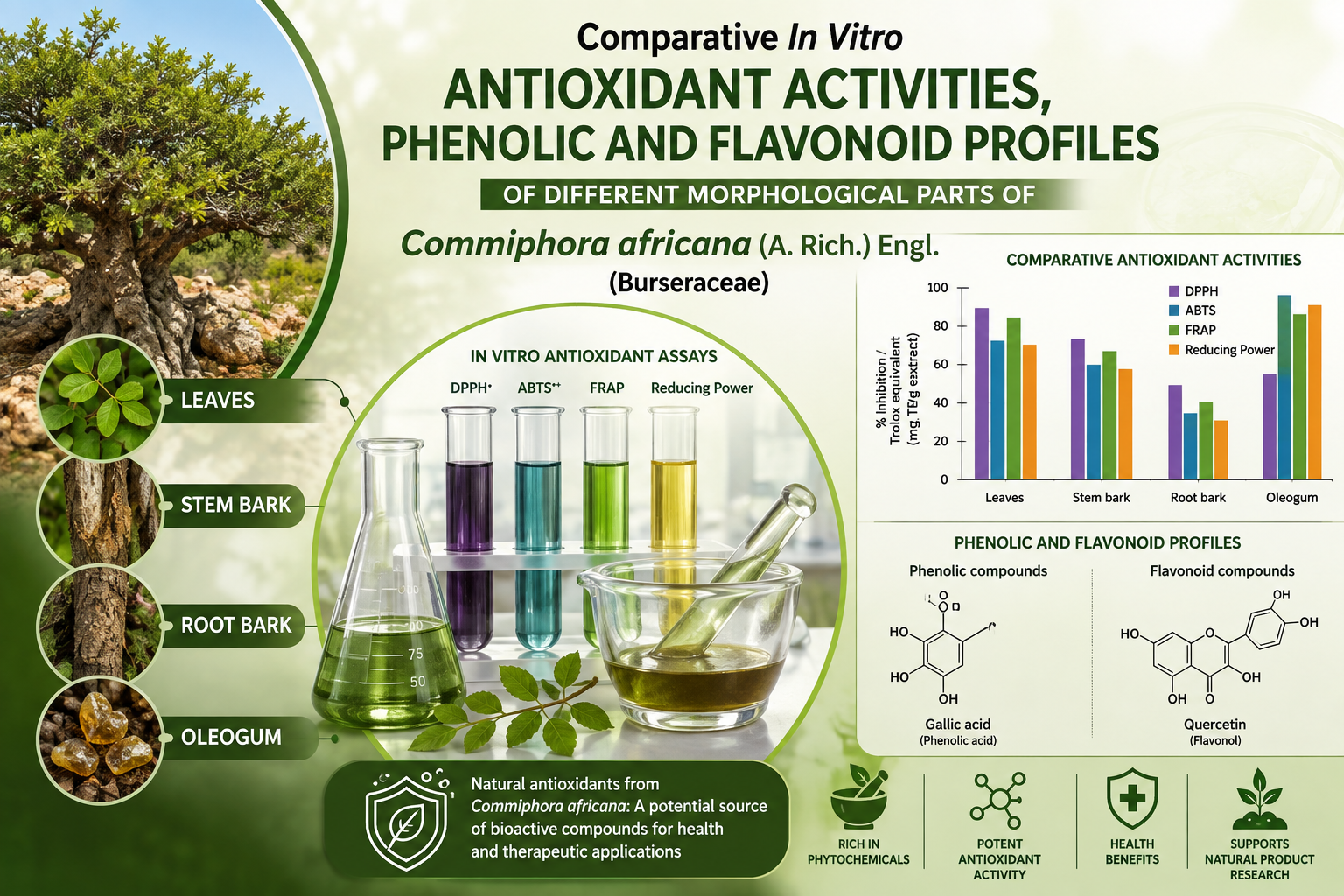
Commiphora africana (A. Rich.) Engl. is widely used in African traditional medicine for managing oxidative stress-related disorders, but scientific validation of this part-specific use remains limited. This study evaluated and compared the antioxidant activities and total phenolic and flavonoid contents of leaf, stem bark, and root bark extracts of C. africana. Powdered plant materials were macerated in 80% aqueous ethanol for 48 h. Antioxidant capacity was assessed using DPPH, hydrogen peroxide (H₂O₂), phosphomolybdenum, and ferric reducing antioxidant power (FRAP) assays, while total phenolic and flavonoid contents were quantified by the Folin–Ciocalteu and aluminum chloride methods. All extracts showed concentration-dependent antioxidant activity. Initial DPPH screening gave IC₅₀ values of 26.90 ± 0.004 (leaf), 58.27 ± 0.006 (stem bark), and 39.34 ± 0.003 μg/mL (root bark), versus 6.43 ± 0.004 μg/mL for ascorbic acid. In extended testing, stem bark outperformed leaf in H₂O₂ scavenging (155.26 vs. 325.43 μg/mL), phosphomolybdenum reduction (1224.25 vs. 1682.33 μg/mL), and FRAP (658.56 vs. 942.17 μg/mL). Total phenolic content was highest in leaf (2.17 mg GAE/g dw); total flavonoid content was highest in stem bark (0.85 mg QE/g dw); all pairwise differences were significant (p < 0.05). The findings demonstrate that the antioxidant activity of Commiphora africana varies among plant parts, with the leaf exhibiting the highest phenolic content and strongest DPPH radical-scavenging activity, while the stem bark showed superior hydrogen peroxide scavenging and reducing power.
References
World Health Organization (WHO), 2022. WHO establishes the Global Centre for Traditional Medicine in India. Available: https://www.who.int/initiatives/who-global-centre-for-traditional-medicine [Accessed 28 July 2026].
Elujoba AA, 2005. Medicinal plants and herbal medicines in the treatment and management of diseases: The Nigerian experience. Nigerian Journal of Natural Products and Medicine, 9: 5-10.
Ahmad SM, Adamu J, Alhassan I, Muhammad IU, 2025. Comparative and combined evaluation of Mitracarpus hirtus and Commiphora africana extracts for antioxidant, antimicrobial, hepatoprotective, and nephroprotective activity. Sokoto Journal of Medical Laboratory Science, 10(3). https://doi.org/10.4314/sjmls.v10i3
Jansen O, Angenot L, Tits M, Nicolas JP, De Mol P, Nikiema JB, Frederich M, 2010. Evaluation of 13 selected medicinal plants from Burkina Faso for their antiplasmodial properties. Journal of Ethnopharmacology, 130(1): 143-150. https://doi.org/10.1016/j.jep.2010.04.021
Compaore M, Meda RNT, Kiendrebeogo M, 2024. Antioxidative, anti-inflammatory potentials and phytochemical profile of Commiphora africana (A. Rich.) Engl. (Burseraceae) and Loeseneriella africana (Willd.) (Celastraceae) stem leaves extracts. Carta Evidence. Available: https://carta-evidence.org/paper/221530e50f766ae5527ae15568c9b9969a6d47777cd5f6b3b493db57b472357d/
Jimoh I, Alhassan I, Asipita PO, Evinemi PA, Musa LA, 2024. An investigation of the phytochemical composition and antimicrobial activities of Commiphora africana stem bark extract. International Journal of Global Sustainable Research, 2(8): 523-530. https://doi.org/10.59890/ijgsr.v2i8.2868
Ezekiel I, Mabrouk MA, Ayo JO, 2010. Study of the effect of hydroethanolic extract of Commiphora africana (stem-bark) on inflammation and pain in rodents. Asian Journal of Medical Sciences, 2(3): 81-84.
Ma J, Jones SH, Hecht SM, 2005. A dihydroflavonol glucoside from Commiphora africana that mediates DNA strand scission. Journal of Natural Products, 68(1): 115-117. https://doi.org/10.1021/np0497000
Sies H, 1997. Oxidative stress: Oxidants and antioxidants. Experimental Physiology, 82(2): 291-295. https://doi.org/10.1113/expphysiol.1997.sp004024
Shahidi F, Ambigaipalan P, 2015. Phenolics and polyphenolics in foods, beverages and spices: Antioxidant activity and health effects - A review. Journal of Functional Foods, 18: 820-897. https://doi.org/10.1016/j.jff.2015.06.018
Khennouf S, Amira S, Arrar L, Baghiani A, 2010. Effect of some phenolic compounds and Quercus tannins on lipid peroxidation. World Applied Sciences Journal, 8(9): 1144-1149.
Spencer JPE, 2012. Flavonoids: Modulators of brain function? British Journal of Nutrition, 108(S1): S12-S20. https://doi.org/10.1017/S0007114512005875
Bin Mokaizh AA, Nour AH, Aini Mahata S, Ukaegbu CI, Elnour AAM, AL-Farga A, 2025. Evaluation of soxhlet extraction parameters for the recovery of improved bioactive compounds from Commiphora gileadensis bark. Grasas y Aceites, 76(2): 2261. https://doi.org/10.3989/gya.1101242.2261
Hossain MA, Al-Raqmi KAS, Al-Mijizy ZH, Weli AM, Al-Riyami Q, 2015. Study of total phenol, flavonoids contents and phytochemical screening of various crude extracts of locally grown Myrtus communis. Asian Pacific Journal of Tropical Biomedicine, 5(8): 676-680. https://doi.org/10.1016/j.apjtb.2015.05.001
Moon, J.K., Shibamoto, T. (2009). Antioxidant assays for plant and food components. Journal of Agricultural and Food Chemistry, 57(5), 1655–1666.
Ruch RJ, Cheng SJ, Klaunig JE, 1989. Prevention of cytotoxicity and inhibition of intercellular communication by antioxidant catechins isolated from Chinese green tea. Carcinogenesis, 10(6): 1003-1008. https://doi.org/10.1093/carcin/10.6.1003
Prieto P, Pineda M, Aguilar M, 1999. Spectrophotometric quantitation of antioxidant capacity through the formation of a phosphomolybdenum complex: Specific application to the determination of vitamin E. Analytical Biochemistry, 269(2): 337-341. https://doi.org/10.1006/abio.1999.4019
Oyaizu M, 1986. Studies on products of browning reaction: Antioxidative activities of products of browning reaction prepared from glucosamine. Japanese Journal of Nutrition, 44(6): 307-315. https://doi.org/10.5264/eiyogakuzashi.44.307
Compaore M, Lamien-Meda A, Mogosan C, Lamien CE, Kiendrebeogo M, Vostinaru O, Kiendrebeogo M, 2011. Antioxidant, diuretic activities and polyphenol content of Stereospermum kunthianum Cham. (Bignoniaceae). Natural Product Research, 25(19): 1777-1788. https://doi.org/10.1080/14786419.2010.529546
Makkar HPS, 2003. Quantification of Tannins in Tree and Shrub Foliage: A Laboratory Manual. Kluwer Academic Publishers: Dordrecht.
Brand-Williams W, Cuvelier ME, Berset C, 1995. Use of a free radical method to evaluate antioxidant activity. LWT - Food Science and Technology, 28(1): 25-30. https://doi.org/10.1016/S0023-6438(95)80008-5
Close DC, McArthur C, 2002. Rethinking the role of many plant phenolics - protection from photodamage not herbivores? Oikos, 99(1): 166-172. https://doi.org/10.1034/j.1600-0706.2002.990117.x
Halliwell B, Gutteridge JMC, 2015. Free Radicals in Biology and Medicine, 5th ed. Oxford University Press: Oxford.
Rice-Evans CA, Miller NJ, Paganga G, 1996. Structure-antioxidant activity relationships of flavonoids and phenolic acids. Free Radical Biology and Medicine, 20(7): 933-956. https://doi.org/10.1016/0891-5849(95)02227-9
Pietta PG, 2000. Flavonoids as antioxidants. Journal of Natural Products, 63(7): 1035-1042. https://doi.org/10.1021/np9904509
Foti MC, 2022. Antioxidant properties of phenols. Journal of Pharmacy and Pharmacology, 74(2): 167-181. https://doi.org/10.1093/jpp/rgab060
Downloads
Published
How to Cite
Issue
Section
License
Copyright (c) 2026 Abdulmumin Z. Abubakar, Umar F. Shehu, Abdulrahman Adamu

This work is licensed under a Creative Commons Attribution 4.0 International License.
All articles published in Advanced Pharmaceutical and Biomedical Letters (AdvPBL) are distributed under an Open Access Creative Commons License BY/4.0. Users are allowed to freely download, read, distribute the materials in any medium or format, remix, reuse the articles or quote the articles, so long as proper attribution is given to the original creators (authors and publishers). Articles may be used for commercial or non-commercial purposes. Users are free to disseminate the work to colleagues or wider scientific community. By submitting their article, the author(s) grant publisher permission to publish, including displaying, storing, copying, and reusing their content.