Comparative Antibacterial Effects of Ethanolic Leaf Extracts of Gambeya albida and Newbouldia laevis on Selected Bacterial Isolates
DOI:
https://doi.org/10.59493/advpbl/2026.1.4Abstract
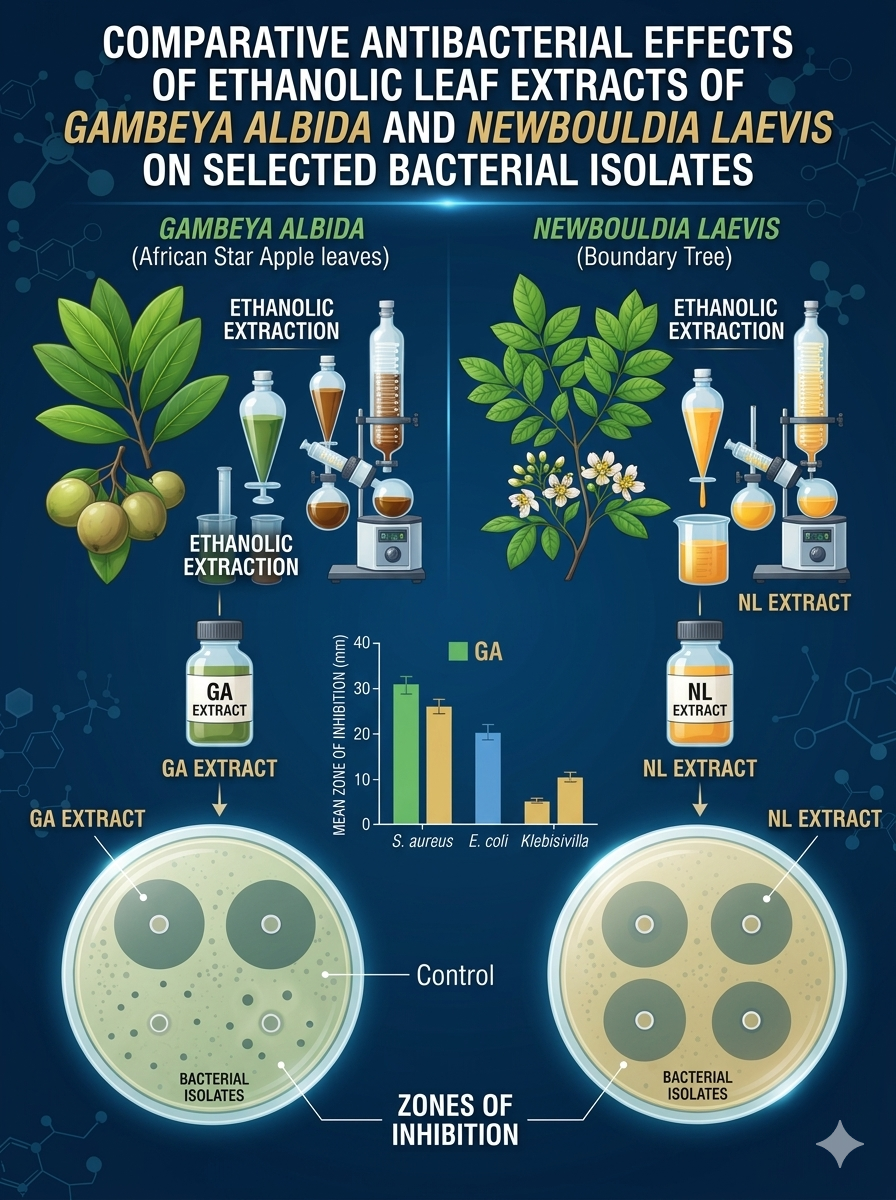
Gambeya albida and Newbouldia laevis are West African medicinal plants traditionally used to treat infectious diseases. This study comparatively evaluated the phytochemical profiles and antibacterial activity of ethanolic leaf extracts of both plants against five clinically sourced bacterial isolates (Escherichia coli, Staphylococcus aureus, Klebsiella spp., Proteus spp., and Pseudomonas aeruginosa). Quantitative phytochemical screening was performed on both extracts, while antibacterial activity was determined by agar well diffusion, with Minimum Inhibitory Concentration (MIC) and Minimum Bactericidal Concentration (MBC) determined by broth microdilution. Alkaloids, flavonoids, tannins, and saponins, were present in both plants at varying concentrations. N. laevis had higher steroids (44.61 mg/g) than alkaloids (12.66 mg/g) content, while G. albida had higher flavonoid (13.7 mg/100g) and tannins (2.56 g/100g) levels. G. albida extract produced the largest inhibition zone diameter (IZD) against E. coli (IZD = 18.5 mm at 100 mg/mL; MIC = 6.25 mg/mL; MBC = 12.5 mg/mL) and moderate activity against S. aureus (IZD = 10 mm; MIC = 50 mg/mL; MBC = 100 mg/mL). N. laevis extract inhibited only E. coli (IZD = 10 mm; MIC = 50 mg/mL; MBC = 100 mg/mL). Neither extract inhibited Proteus spp., P. aeruginosa, or Klebsiella spp. The difference in antibacterial activity against E. coli between the two extracts was statistically significant (p = 0.0002 at 100 mg/ml; p = 0.0010 at 50 mg/ml). These findings validate the traditional use of G. albida in managing bacterial infections and support its potential as a complementary antimicrobial agent.
References
Nwachukwu MI, Duru MKC, Nwachukwu IO, Obasi CC, Uzoechi AU, Ezenwa CM, Anumodu CK, 2017. In-vitro phytochemical characterization and antibacterial activity of Newbouldia Laevis (boundary tree) on Escherichia Coli and Staphylococcus Aureus. Asian Journal of Microbiology and Biotechnology, 2 (1):30-36
World Health Organization, 2023. Global antimicrobial resistance and use surveillance system (GLASS) report. Geneva: WHO Press.
Kaper JB, Nataro JP, Mobley HLT, 2004. Pathogenic Escherichia coli. Nature Reviews Microbiology, 2(2):123–140.
Whelan S, Lucey B, Finn K, 2023. Uropathogenic Escherichia coli (UPEC)-associated urinary tract infections: the molecular basis for challenges to effective treatment. Microorganisms, 11(9):2169.
Osuala OJ, Maduakor JG, Ezemba CC, Etikudike VO, Ike VE, Nnadi CO, Oli AN, 2025. Isolation and characterisation of carbapenemase-producing Escherichia coli isolates from fomites in Madonna University, Elele Campus, Rivers State, Nigeria. Advanced Pharmaceutical and Biomedical Letters, 2(1):27–32.
Tong SYC, Davis JS, Eichenberger E, Holland TL, Fowler VG, 2015. Staphylococcus aureus infections: epidemiology, pathophysiology, clinical manifestations, and management. Clinical Microbiology Reviews, 28(3):603–661.
Paczosa MK, Mecsas J, 2016. Klebsiella pneumoniae: going on the offense with a strong defense. Microbiology and Molecular Biology Reviews, 80(3):629–661.
Wasfi R, Hamed SM, Amer MA, Fahmy LI, 2020. Proteus mirabilis biofilm: development and therapeutic strategies. Frontiers in Cellular and Infection Microbiology, 10:414.
Moradali MF, Ghods S, Rehm BHA, 2017. Pseudomonas aeruginosa lifestyle: a paradigm for adaptation, survival, and persistence. Frontiers in Cellular and Infection Microbiology, 7:39.
Odewade JO, Odewade LO, 2023. Evaluation of antibacterial and antioxidant properties of leaf extract of Chrysophyllum albidum against selected enteric bacterial pathogens. FUDMA Journal of Sciences, 7(2):131–140.
Adonu C, Ali I, Omeh R, 2023. Phytochemical screening and antibacterial activity of Chrysophyllum albidum collected in Nsukka, South East Nigeria. European Journal of Medicinal Plants, 34(6):13-22.
Azih I, Ijezie M, Ugariogu SN, Akalezi CO, 2020. Antibacterial activity and identification of metabolites from the semi-purified fraction of Chrysophyllum albidum leaf (African star apple). Tropical Journal of Natural Product Research, 4(7):262–269.
Nartey D, Gyesi JN, Borquaye LS, 2021. Chemical composition and biological activities of the essential oils of Chrysophyllum albidum G. Don (African star apple). Biochemistry Research International, (1):9911713.
Anaduaka EG, Ogugua VN, Egba SI, Apeh VO, 2013. Investigation of some important phytochemical, nutritional properties and toxicological potentials of ethanol extracts of Newbouldia laevis leaf and stem. African Journal of Biotechnology, 12(40):5941-5949
Harborne AJ, 1998. Phytochemical methods a guide to modern techniques of plant analysis, 3rd ed., Chapman and Hall Ltd: London.
Trease GE, Evans WC, 2002. Pharmacognosy. 15th ed. Saunders Publishers: London.
Cheesbrough M, 2006. District laboratory practice in tropical countries, Part 2. 2nd ed. Cambridge University Press: Cambridge.
Dike MC, Nnamdi EA, 2012. Comparative study of proximate, phytochemical and mineral compositions of edible plant fruits/seeds from Nigerian rainforest. International Journal of Biological and Chemical Sciences, 6(4): 1905-1909.
Jubair N, Rajagopal M, Chinnappan S, Abdullah NR, Fatima A, 2021. Review on the antibacterial mechanism of plant-derived compounds against multidrug-resistant bacteria. Evidence‐Based Complementary and Alternative Medicine, 2021:3663315.
Ujam NT, Nwobodo VC, Adonu CC, Ali I, Okorie NH, Ejikeugwu CE, Ajaegbu EE, 2024. The phyto-chemical screening, antibacterial and antipyretic properties of extracts of Chrysophyllum albidum leaves. International Journal of Research and Innovation in Applied Science, 9(3):461-472.
Akinpelu DA, Odewade JO, Aiyegboro OA, Ashafa AOT, Akinpelu OF, Agunbiade MO, 2016. Biocidal effects of stem bark extract of Chrysophyllum albidum G. Don on vancomycin-resistant Staphylococcus aureus. BMC Complementary and Alternative Medicine, 16:105
Andrew UE, Mbanefo F, Osigwe CC, Okokon JE, Uwaeme UF, Johnny II, 2025. Evaluation of genotoxic and cytotoxic activities of stem extract of Telfairia occidentalis. Advanced Pharmaceutical and Biomedical Letters, 2(1):20–26.
Downloads
Published
How to Cite
Issue
Section
License
Copyright (c) 2026 Ogechukwu C. Dozie-Nwakile, Calistus D. Nwakile, Ebere A. Onyebueke, Ferdinand C. Onwuka, Oluchi M. Okeh, Iniekong P. Udoh, Aghatise K. Erhamwonyi, Rebecca C. Edu, Seto T. Aladenika

This work is licensed under a Creative Commons Attribution 4.0 International License.
All articles published in Advanced Pharmaceutical and Biomedical Letters (AdvPBL) are distributed under an Open Access Creative Commons License BY/4.0. Users are allowed to freely download, read, distribute the materials in any medium or format, remix, reuse the articles or quote the articles, so long as proper attribution is given to the original creators (authors and publishers). Articles may be used for commercial or non-commercial purposes. Users are free to disseminate the work to colleagues or wider scientific community. By submitting their article, the author(s) grant publisher permission to publish, including displaying, storing, copying, and reusing their content.