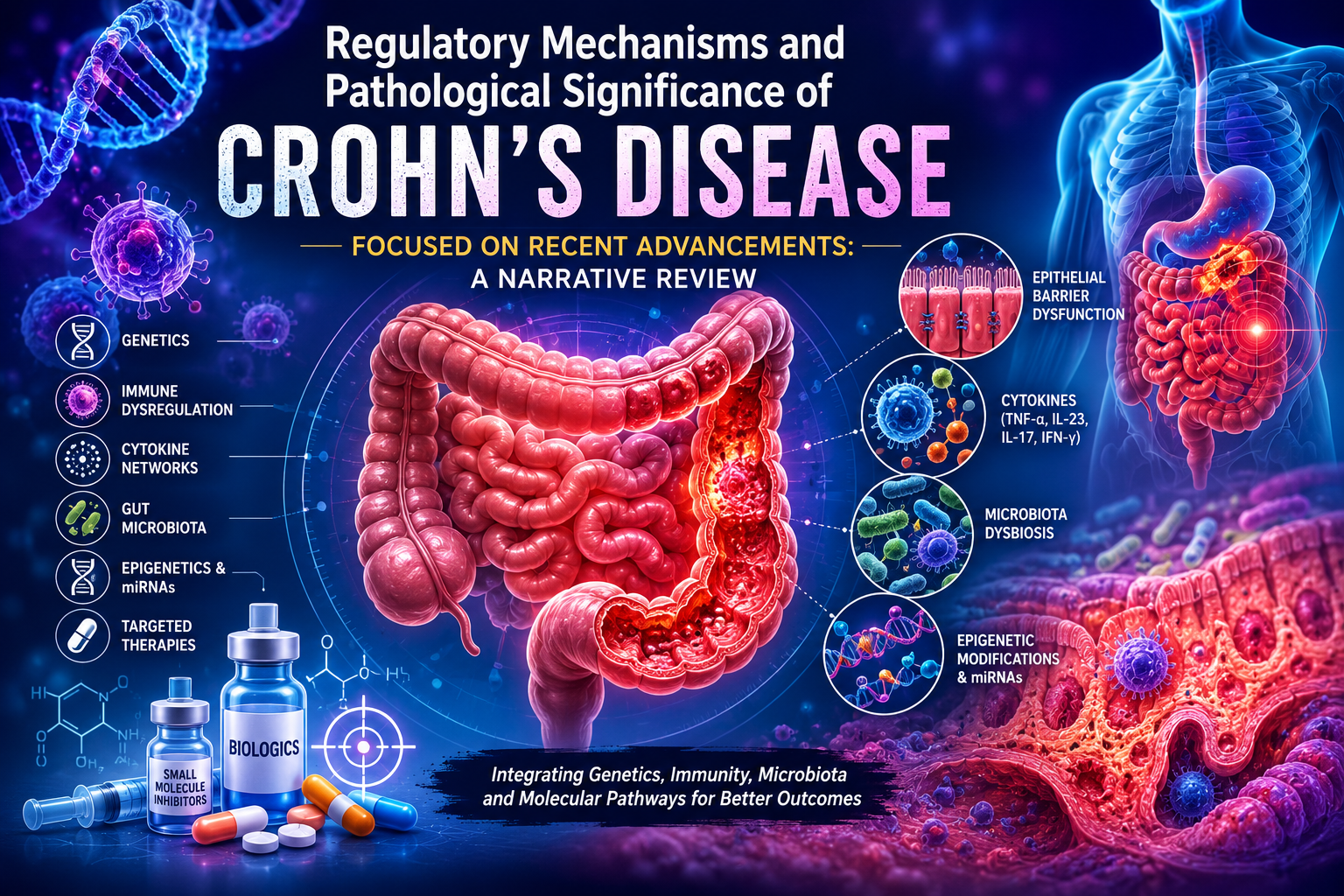
Regulatory Mechanisms and Pathological Significance of Crohn’s Disease Focused on Recent Advancements: A Narrative Review
DOI:
https://doi.org/10.59493/advpbl/2026.1.3Abstract
Crohn’s disease is a multifactorial inflammatory bowel disease that involves genetic susceptibility, dysregulated immune responses, and environmental triggers. This study was a narrative review of the regulatory mechanisms and pathological significance of Crohn’s disease. Scientific databases were searched, including: PUBMED, Embase, Google Scholar, Web of Science, and Scopus. The studies considered were original research articles, meta-analyses, randomized controlled trials, and systematic reviews published between 2020 and 2026. A total of 118 articles were screened for eligibility (except those articles used during the ‘Introduction section’). A total of 98 articles were eligible, while 20 were ineligible. The articles reviewed provided information on the fundamental pathophysiology of Crohn’s disease and its regulatory mechanisms; genetic and molecular drivers; immune regulation and dysregulation; the microbiome and environmental factors; and emerging therapeutic targets and mechanisms. The fundamental pathophysiology and regulatory mechanisms identified include: intestinal barrier dysfunction, defective bacterial clearance, transmural inflammation and granuloma formation, fibrosis and stricture formation, and mesenteric fat hypertrophy. Other parameters highlighted were the microbiome and environmental factors, including dysbiosis of the gut microbiota, smoking, dietary factors, and vitamin D deficiency. Others were medications, psychological and environmental stress, infections, urbanization, pollution, and exposomes. New findings include: exposome-diet epigenome and E-cigarettes. Emerging therapeutic targets and mechanisms were emphasized: anti-TNF/IL-12/IL-23 inhibitors, adhesion molecule inhibitors, restoring barrier formation, and mesentery-based surgery. Despite Crohn’s disease being studied extensively, and many pathophysiological and regulatory mechanisms elucidated, there has not been a radical cure for the ailment. This necessitated research and a consequent development of new treatment approaches.
References
Dolinger M, Torres J, Vermeire S. Crohn's disease, 2024. The Lancet, 403 (10432): 1177-1191. https://doi.org/10.1016/S0140-6736(23)02586-2
Michael WW, Joel VW, 2020. Chapter 46 - Inflammatory Bowel Disease. The Autoimmune Diseases (Sixth Edition). Academic Press, p 871-894. https://doi.org/10.1016/B978-0-12-812102-3.00046-4
da Silva Júnior RT, Apolonio JS, de Souza NJO, da Costa BT, Malheiro LH, Silva LM, de Carvalho LS, da Silva Santos C, de Melo FF. 2023. Crohn's disease and clinical management today: How does it work? World Journal of Methodology, 13 (5): 399–413. https://doi.org/10.5662/wjm.v13.i5.399
Cicero G & Mazziotti S, 2021. Crohn's disease at radiological imaging: focus on techniques and intestinal tract. Intestinal Research, 19 (4): 365–378. https://doi.org/10.5217/ir.2020.00097
Cushing K, Higgins PDR, 2021. Management of Crohn Disease: A Review. JAMA, 325 (1): 69-80. https://doi.org/10.1001/jama.2020.18936
D'Amico F, Massironi S, Allocca M, Danese S, 2023. Advancing transmural remission as a treatment target in Crohn's disease: The future of tight-control strategy? United European Gastroenterology Journal, 11 (10): 948-950. https://doi.org/10.1002/ueg2.12495
Girgis P, Lnu T, Ahmad A, Daniel M, Kamel M, Gambill JI, Shahzadi A, Khan U, Zara A, Sharma V, 2024. Advancements in Targeted Therapies for the Management of Crohn's Disease: A Comprehensive Review. Cureus, 16 (6): e61751. https://doi.org/10.7759/cureus.61751
Pasternak G, Chrzanowski G, Aebisher D, Myśliwiec A, Dynarowicz K, Bartusik-Aebisher D, Sosna B, Cleslar G, Kawczyk-krupka A, Filip R,, 2023. Crohn’s Disease: Basic Characteristics of the Disease, Diagnostic Methods, the Role of Biomarkers, and Analysis of Metalloproteinases: A Review. Life, 13 (10): 2062. https://doi.org/10.3390/life13102062
Bargas A, Palmela C, Glória L, 2025. Enteral Nutrition in Crohn's Disease: A Comprehensive Review of Its Role in Induction and Maintenance of Remission and Perioperative Management in Adult Patients. Nutrients, 17 (9): 1481. https://doi.org/10.3390/nu17091481
Chrzanowski G, Pasternak G, Aebisher D, Dynarowicz K, Myśliwiec A, Aebisher DB, Sosna B, Cleslar G, Kawczyk-krupka A, Filip R, 2023. An Analysis of the Content of Metalloproteinases in the Intestinal Wall of Patients with Crohn's Disease. Life (Basel), 13 (10): 2013. https://doi/10.3390/life13102013
Karabulut A*, Kaya M, 2023. Crohn’s disease from past to present: Research trends and global outcomes with scientometric analysis during 1980 to 2022. Medicine, 102 (35): e34817. https://doi.org/10.1097/MD.0000000000034817
Thompson JM, 2024. Crohn’s Disease: An Overview of Pathogenesis, Diagnosis, and Management. Acute Chronic Dis. Short Communication, 8(3): 231. doi: 10.35248/ACDR.24.8.231
Giorgos B. & Cominelli F, 2021. Exploring the Early Phase of Crohn’s Disease. Clinical Gastroenterology and Hepatology, 19 (12): 2469-2480. Accessed 3 March 2026.
Fan YH, Wang MW, Gao YN, Li WM, Jiao Y, 2025. Genetic and environmental factors influencing Crohn's disease. World Journal of Gastrointestinal Surgery, 17 (3): 98526. https://doi.org/10.4240/wjgs.v17.i3.98526
Chandwaskar R, Dalal R, Gupta S, Sharma A, Parashar D, Kashyap VK, Sohal JS, Tripathi SK, 2024. Dysregulation of T cell response in the pathogenesis of inflammatory bowel disease. Scandinavian Journal of Immunology, 100: e13412. https://doi.org/10.1111/sji.13412
Cervera-Seco L, Baldán-Martín M, Fernández-Tomé S, Moreno LO, Lozano JJ, Aransay AM, Chaparro M, Gisbert JP, Marigorta UM, 2025. Characterization of the Regulatory Landscape in Crohn’s Disease Reveals microRNA-Associated Alterations that Shape Anti-TNF Response, Inflammatory Bowel Diseases, 31 (7): 980-1993. https://doi.org/10.1093/ibd/izaf029
Hayashi Y and Nakase H, 2022. The Molecular Mechanisms of Intestinal Inflammation and Fibrosis in Crohn’s Disease. Frontiers in Physiology, 13: 845078. https://doi.org/10.3389/fphys
Yuan Z, Ye J, Liu B, Zhang L, 2024. Unraveling the role of autophagy regulation in Crohn's disease: from genetic mechanisms to potential therapeutics. Biotechnology Advances, (2): 14. https://doi.org/10.1007/s44307-024-00021-z
Patra S, Chaudhary S, Samal SC, Ayyanar P, Padhi S, Nayak HK, 2025. FoxP3-positive T regulatory cells and their effector mechanisms in Crohn’s disease: an immunohistochemical and image morphometric analysis on endoscopic mucosal biopsies. European Journal of Gastroenterology & Hepatology, 37 (7): 799-809. https://doi.org/10.1097/MEG.0000000000002971
Kong L, Pokatayev V, Lefkovith A, Carter GT, Creasey EA, Krishna C, Subramanian S, Kochar B, Ashenberg O, Lau H, Ananthakrishnan AN, Graham DB, Deguine J, Xavier RJ, 2023. The landscape of immune dysregulation in Crohn’s disease was revealed through single-cell transcriptomic profiling in the ileum and colon. Immunity, 56 (2): 444-458.e5. https://doi.org/10.1016/j.immuni.2023.01.002
Longman RS, 2024. Multiomics Resolves Regulatory Mechanisms in a Diverse Cohort of Crohn’s Disease, Journal of Crohn's and Colitis, 18 (12): 1937–1938. https://doi.org/10.1093/ecco-jcc/jjae154
Calvez V, Puca P, Di Vincenzo F, Del Gaudio A, Bartocci B, Murgiano M, Iaccarino J, Parand E, Napolitano D, Scaldaferri F, 2025. Novel Insights into the Pathogenesis of Inflammatory Bowel Diseases. Biomedicines, 13 (2): 305. https://doi.org/10.3390/biomedicines13020305
Yang, X., Guo, H. & Zou, M, 2026. Inflammatory bowel diseases: pathological mechanisms and therapeutic perspectives. Molecular Biomedicine, 7 (2). https://doi.org/10.1186/s43556-025-00395-z
Dunleavy KA, Raffals LE, Camilleri M, 2023. Intestinal Barrier Dysfunction in Inflammatory Bowel Disease: Underpinning Pathogenesis and Therapeutics. Digestive Diseases and Sciences, 68 (12): 4306-4320. https://doi.org/10.1007/s10620-023-08122-w
Selvakumar B, Samsudin R, 2025. Intestinal Barrier Dysfunction in Inflammatory Bowel Disease: Pathophysiology to Precision Therapeutics. Inflammatory Bowel Diseases, 31 (12): 3450–3464. https://doi.org/10.1093/ibd/izaf225.
Nakai D, Miyake M, 2024. Intestinal Membrane Function in Inflammatory Bowel Disease. Pharmaceutics, 16 (1): 29. https://doi.org/10.3390/pharmaceutics16010029
Zhao Z, Liu X, Zhang R, Ke R, Zhang S, Chen Y, 2025. Intestinal Barrier in Inflammatory Bowel Disease: Mechanisms and Treatment. Journal of Translational Gastroenterology, 3 (2): 62-73. https://doi.org/10.14218/JTG.2024.00038
Ghate A, Uhlig H, 2023. Defective microbial sensing and clearance in perianal Crohn's disease: a role for complement factor B. Gut, 72 (11): 2010-2012. https://doi.org/10.1136/gutjnl-2023-329801
Linares R, Francés R, Gutiérrez A, Juanola O, 2021. Bacterial Translocation as Inflammatory Driver in Crohn's Disease. Frontiers in Cell and Developmental Biology, 9: 703310. https://doi.org/10.3389/fcell. 2021.703310
Bamias G, Cominelli F, 2021. Exploring the Early Phase of Crohn's Disease. Clinical Gastroenterology and Hepatology, 19 (12): 2469-2480. https://doi.org/10.1016/j.cgh.2020.09.023
Petagna L, Antonelli A, Ganini C, Bellato V, Campanelli M, Divizia A, Efrati C, Franceschilli M, Guida AM, Ingallinella S, Montagnese F, Sensi B, Siragusa L, & Sica GS, 2020. Pathophysiology of Crohn's disease inflammation and recurrence. Biology Direct, 15 (1): 23. https://doi.org/10.1186/s13062-020-00280-5
Tian C, Ranasinghe IR, Hsu R, 2025. Crohn's Disease. [Updated 2025 Dec 1]. In: StatPearls [Internet]. Treasure Island (FL): StatPearls Publishing; 2026 Jan-. Available from: https://www.ncbi.nlm.nih.gov/books/NBK436021/ (Accessed 5 March 2026).
Amarnath S, Deeb L, Philipose J, Zheng X, Gumaste VA, 2021. Comprehensive Review of Infectious Granulomatous Diseases of the Gastrointestinal Tract. Gastroenterology Research and Practice, 8167149. https://doi.org/10.1155/2021/8167149
Alfredsson J, Wick MJ, 2020. Mechanism of fibrosis and stricture formation in Crohn's disease. Scandinavian Journal of Immunology, 92 (6): e12990. https://doi.org/10.1111/sji.12990
Yoo JH, Holubar S, Rieder F, 2020. Fibrostenotic strictures in Crohn's disease. Intestinal Research, 18 (4): 379-401. https://doi.org/10.5217/ir.2019.09148
Fousekis FS, Mpakogiannis K, Mastorogianni IN, Lianos GD, Christodoulou DK, Katsanos KH, 2025. Intestinal Fibrosis in Crohn’s Disease: Pathophysiology, Diagnosis, and New Therapeutic Targets. Journal of Clinical Medicine, 14 (12): 4060. https://doi.org/10.3390/jcm14124060
Rieder F, Mukherjee PK, Massey WJ, Wang Y, Fiocchi C, 2024. Fibrosis in IBD: from pathogenesis to therapeutic targets. Gut, 73 (5): 854-866. https://doi.org/10.1136/gutjnl-2023-329963
Wang Q, Li H, Huan Y, Zhou T, Zhang J, Fang R, Sun Y, Lan A, Xu W, 2025. Adipose tissue: an inflammatory organ that cannot be ignored in periodontal disease related to obesity. Frontiers in Immunology, 16: 1698207. https://doi.org/10.3389/fimmu. 2025.1698207
Martín-Reyes F, Kentaoui-Bousellam I, Ruiz-Malagón AJ, López-Gómez C, Herraiz-Vilela M, Herraiz-Vilela M, Alcaín-Martínez G, Camargo-Camero R, Martos-VanDussen JV, Camacho-Martel L, Gutiérrrez-Martínez F, Arranz-Salas I, Ortega-Jimenez MV, Escamilla-Sánchez A, Daza-González JJ, Sanchiz-Cardenas E, Rivas-Becerra J, García-Fuentes E, Rodríguez-Pacheco F, & Rodriguez-Diaz C, 2025. Mesenteric adipose tissue in Crohn’s disease alters the immune response of the ileal mucosa and increases angiogenesis and fibrosis. Scientific Reports, 15: 22591. https://doi.org/10.1038/s41598-025-07147-7
Coffey J, Bai L, Wu F, 2024. Catching up with Creeping Fat: Unravelling the Mysteries of the Mesentery in Crohn's Disease. Gastroenterology, 168: 454-456. Accessed 5 March 2026.
Li LZ, Zhang YY, Cui XF, Ma JJ, Wang D, Zhang HJ, 2020. Chinese Journal of Internal Medicine, 59 (9): 711-715. https://doi.org/10.3760/cma.j.cn112138-20191213-00816
Koifman E, Cohen IS, Lopez-Alonso R, Hur DB, Ilivitzki A & Waterman M, 2025. Mesenteric fat proliferation on magnetic resonance enterography is a predictor of long-term disease complications in Crohn’s disease. BMC Gastroenterology, 25: 593. https://doi.org/10.1186/s12876-025-04085-6
Li Z, 2026. Genetically Validated Immune Susceptibility Markers for Crohn's Disease: A Multi-Omics Mendelian Randomization Analysis. JGH Open, 10 (1): e70332. https://doi.org/10.1002/jgh3.70332
González-Serna D, Ochoa E, López-Isac E, Julià A, Degenhardt F, Ortego-Centeno N, Radstake TRDJ, Franke A, Marsal S, Mayes MD, Martín J, Márquez A & Scleroderma GC, 2020. Scleroderma Genetic Consortium A cross-disease meta-GWAS identifies four new susceptibility loci shared between systemic sclerosis and Crohn’s disease. Scientific Reports, 10: 1862. https://doi.org/10.1038/s41598-020-58741-w
Kugathasan S, Fiocchi C, 2025. Towards IBD Prediction and Prevention: The Contribution of Genetics and Genomics. Inflammatory Bowel Diseases, 31 (Supplement_2): S3–S13. https://doi.org/10.1093/ibd/izaf206
Kayali S, Fantasia S, Gaiani F, Cavallaro LG, de’Angelis GL, Laghi L, 2025. NOD2 and Crohn’s Disease Clinical Practice: From Epidemiology to Diagnosis and Therapy, Rewired. Inflammatory Bowel Diseases, 31 (2): 552–562. https://doi.org/10.1093/ibd/izae075
Dixon CL, Wu A, and Fairn GD, 2023. Multifaceted roles and regulation of nucleotide-binding oligomerization domain-containing proteins. Frontiers in Immunology, 14: 1242659. https://doi.org/10.3389/fimmu2023.1242659
Ashton JJ, Seaby EG, Beattie RM, Ennis S, 2023. NOD2 in Crohn’s Disease—Unfinished Business. Journal of Crohn's and Colitis, 17 (3): 450-458. https://doi.org/10.1093/ecco-jcc/jjac124
Wang Y, Mi Z, Liu H, Zhang F, 2024. NOD2 in signaling, immunity, and mycobacterial infection. Authorea, Immunity, Inflammation and Disease, Preprint 6 April 2024; https://doi.org/10.22541/au.171239819.95495747/v1
Bichalska-Lach M, Waniczek D, Kowalczyk P, Śnietura M, Kryj M, Bednarczyk M, 2026. Autophagy Dysregulation in Crohn’s Disease and Colorectal Cancer—An Analysis of BECN1, PINK1, and LAMP2 Gene Expression. Current Issues in Molecular Biology, 48 (1): 31. https://doi.org/10.3390/cimb48010031
Lin R, Xu Z, Zhi M, 2026. Canonical pathways and selective mechanisms of autophagy in inflammatory bowel disease. Advanced Biotechnology (Singapore), 4 (1): 4. https://doi.org/10.1007/s44307-026-00094-y
Múnera-Rodríguez AM, Leiva-Castro C, Reina-Pérez I, Benítez-Márquez JM, Palomares F, López-Enríquez S, 2026. The Role of Autophagy in Inflammatory Diseases: Challenges and Therapeutic Potential, Inflammatory Bowel Diseases, 32 (3): 562–571. https://doi.org/10.1093/ibd/izaf279
Creoli M, Buono P, Cenni S, Casertano M, Vitale A, Maglio M, 2026. Pharmacological Modulation of Autophagy Corrects Cellular Defects in Pediatric Crohn’s Disease. Molecular and Cellular Biology, 46 (2): 270–280. https://doi.org/10.1080/10985549.2025.2583173
Schirone D, Paolo MC, Vecchio D, Nocella CD,Amico A, Urgesi R, Pallotta L, Fanello G, Villotti G, Graziani MG, Peruzzi M, De Falco E, Carnevale R, Sciarretta S, Frati G & Pagnini C, 2024. Stenosing Crohn’s disease patients display gut autophagy/oxidative stress imbalance. Scientific Reports, 14: 27312. https://doi.org/10.1038/s41598-024-79308-z
Miao Z-X, Meng H, Wang J, Hou X-T, Cheng W-W, Liu B-H, Zhang Q, Yuan S,, 2025. Autophagy in inflammatory bowel disease: immunization, etiology, and therapeutic potential. Frontiers in Immunology, 16: 1543040. https://doi.org/10.3389/fimmu.2025.1543040
Subramanian AJA, Kumarasamy V, Begum MY, Sekar M, Subramaniyan V, Wong LS, Sekar M, 2024. Exploring the Connections: Autophagy, Gut Microbiota, and Inflammatory Bowel Disease Pathogenesis. Journal of Inflammation Research, 17: 10453-10470. https://doi.org/10.2147/JIR.S483958
Okai N, Watanabe T, Minaga K, Kamata K, Honjo H, Kudo M, 2022. Alterations of autophagic and innate immune responses by the Crohn’s disease-associated ATG16L1 mutation. World Journal of Gastroenterology, 28 (26): 3063-3070. https:/doi.org/10.3748/wjg.v28.i26.3063
Haq S, Wang H, Grondin J, Banskota S, Marshall JK, Khan II, 2021. Disruption of autophagy by increased 5-HT alters gut microbiota and enhances susceptibility to experimental colitis and Crohn’s disease. Science Advances, 7: 6442. https://doi.org/10.1126/sciadv.abi6442
Alula KM, Theiss AL, 2023. Autophagy in Crohn’s Disease: Converging on Dysfunctional Innate Immunity. Cells, 12 (13): 1779. https://doi.org/10.3390/cells12131779
Rodrigues BL, Pascoal LB, Genaro LM, Warrak LSCA, Rodrigues BAG, Coope A, Camargo MG, Oliveira PDP, Ayrizono MDS, Leal RF, 2025. In Vitro Inhibition of Endoplasmic Reticulum Stress: A Promising Therapeutic Strategy for Patients with Crohn's Disease. Cells, 14 (4): 270. https://doi.org/10.3390/cells14040270
Zheng T, Huang KY, Tang XD, Wang FY, Lv L, 2025. Endoplasmic reticulum stress in gut inflammation: Implications for ulcerative colitis and Crohn's disease. World Journal of Gastroenterology, 31 (13): 104671. https://doi.org/10.3748/wjg.v31.i13.104671
Ziyu L, Zahra Z, Tao H, Yingying H, Lushan P, Dan W, Zhou Z, Ousmane D, Wang J, 2024. Identification of endoplasmic reticulum stress-associated genes and subtypes for predicting risk signature and depicting immune features in inflammatory bowel disease, Heliyon, 10 (17): e37053. https://doi.org/10.1016/j.heliyon.2024.e37053
Eugene SP, Reddy VS, and Trinath J, 2020. Endoplasmic Reticulum Stress and Intestinal Inflammation: A Perilous Union. Frontiers in Immunology, 11: 543022. https://doi.org/10.3389/fimmu.2020.543022
Alula KM, Nguyen TT, & de Zoeten EF, 2026. Regulation of intestinal regulatory T cells via stress response pathways in inflammatory bowel disease. Autoimmunity, 59 (1). https://doi.org/10.1080/08916934.2025.2602715
Schmitt H, Neurath MF, Atreya R, 2021. Role of the IL23/IL17 Pathway in Crohn's Disease. Frontiers int Immunology, 12: 622934. https://doi.org/10.3389/fimmu2021.622934
Vuyyuru SK, Shackelton LM, Hanzel CM, Vipul J & Brian GF, 2023. Targeting IL-23 for IBD: Rationale and Progress to Date. Drug, 83: 873–891. https://doi.org/10.1007/s40265-023-01882-9
Ji-Hyun P, Min Hyeok L, Chan-Su P*, 2024. Inflammatory bowel disease pathogenesis mediated by Th17 cells: cytokines, microbiota, and therapies. Journal of Biomedical and Translational Research, 25 (2): 15-32. https://doi.org/10.12729/jbtr.2024.25.2.15
Chen L, Ruan G, Cheng Y, Yi A, Chen D and Wei Y, 2023. The role of Th17 cells in inflammatory bowel disease and the research progress. Frontiers in Immunololgy, 13: 1055914. https://doi.org/10.3389/fimmu.2022.1055914
Pastras P, Aggeletopoulou I, Papantoniou K, Triantos C, 2025. Targeting the IL-23 Receptor Gene: A Promising Approach in Inflammatory Bowel Disease Treatment. International Journal of Molecular Sciences, 26 (10): 4775. https://doi.org/10.3390/ijms26104775
Hu Y, Yang Y, Li Y, Zhang Q, Zhang W, Jia J, 2025. Th17/Treg imbalance in inflammatory bowel disease: immunological mechanisms and microbiota-driven regulation. Frontiers in Immunology, 16: 1651063. https://doi.org/10.3389/fimmu2025.1651063
Gavin WS, Arthur K, 2022. Interleukin-23 in the Pathogenesis of Inflammatory Bowel Disease and Implications for Therapeutic Intervention, Journal of Crohn's and Colitis, 16 (Supplement_2): ii3–ii19. https://doi.org/10.1093/ecco-jcc/jjac034
Monteleone G, Calisi C, Salvatori S, and Marafini I, 2025.vFundamental and emerging insights into innate and adaptive immunity in inflammatory bowel diseases. Frontiers in Immunology, 16: 165530. https://doi.org/10.3389/fimmu.2025.1665530
Yue N, Hu P, Tian C, Kong C, Zhao H, Zhang Y, 2024. Dissecting Innate and Adaptive Immunity in Inflammatory Bowel Disease: Immune Compartmentalization, Microbiota Crosstalk, and Emerging Therapies. Journal of Inflammation Research, 17: 9987-10014. https://doi.org/10.2147/JIR.S492079
Darmadi D1*, Riska HR, 2021. Immunological Aspect in Inflammatory Bowel Disease. Open Access Macedonian Journal of Medical Sciences, 9 (F): 708-711. https://doi.org/10.3889/oamjms.2021.7733
Mousa RS, Invernizzi P, and Mousa HS, 2024. Innate immune cells in the pathogenesis of inflammatory bowel disease -from microbial metabolites to immune modulation. Frontiers in Gastroenterology, 3: 1452430. https://doi.org/10.3389/fgstr2024.1452430
Yuyuan H, Yuhang Y, Yan L, Qiang Z, Wei Z, Jinxi W*, Han Z, Wang J, 2025. Th17/Treg imbalance in inflammatory bowel disease: immunological mechanisms and microbiota-driven regulation. Frontiers in Immunology, 16: 1651063. https://doi.org/10.3389/fimmu.2025.1651063
Sznurkowska KT, 2025. Regulatory Cells in Inflammatory Bowel Disease—Are They Major Players? International Journal of Molecular Sciences, 26 (24): 11944. https://doi.org/10.3390/ijms262411944
Chaelin L, Ye WP, Min HP, Yong JL, Inmoo R, 2025. Regulatory T cells and their role in inflammatory bowel disease: molecular targets, therapeutic strategies and translational advances. Biochemical Pharmacology, 239: 117087. https://doi.org/10.1016/j.bcp.2025.117087
Clough JN, Omer OS, Tasker S, Lord GM, Irving PM, 2020. Regulatory T-cell therapy in Crohn’s disease: challenges and advances. Recent advances in basic science, Gut, 69: 942-952. Accessed March 2026.
Jiménez JM, Contreras-Riquelme JS, Vidal PM, Prado C, Bastías M, Meneses C, Martín AJM, Perez-Acle T & Pacheco R, 2024. Identification of master regulator genes controlling pathogenic CD4+ T cell fate in inflammatory bowel disease through transcriptional network analysis. Scientific Reports, 14: 10553.
https://doi.org/10.1038/s41598-024-61158-4
Jacobse J, Li J, Rings EHHM, Samsom JN and Goettel JA, 2021. Intestinal Regulatory T Cells as Specialized Tissue-Restricted Immune Cells in Intestinal Immune Homeostasis and Disease. Frontiers in Immunology, 12: 716499. https;//doi.org/10.3389/fimmu2021.716499
Laukova M. and Glatman ZA, 2023. Regulatory T cells as a therapeutic approach for inflammatory bowel disease. European Journal of Immunology, 53: 2250007. https://doi.org/10.1002/eji.202250007
Jalalvand M, Enayati S, Akhtari M, Madreseh E, Jamshidi A, Farhadi E, Mahmoudi M, Amirzargar A, 2023. Blood regulatory T cells in inflammatory bowel disease: a systematic review and meta-analysis. International Immunopharmacology, 117: 109824. https://doi.org/10.1016/j.intimp.2023.109824
Negi S, Saini S, Tandel N, Sahu K, Mishra RPN, Tyagi RZ, 2021. Translating Treg Therapy for Inflammatory Bowel Disease in Humanized Mice. Cells, 10 (8): 1847. https://doi.org/10.3390/cells10081847
Wang L, Wang S, Lin J, Jiajia L, Mingyuan W, Jiang Y, Sun J, Tang N, Jiao C, Ma J, Zhao X, & Zhang H, 2025. Treg and intestinal myofibroblast-derived Amphiregulin induced by TGF-β mediates intestinal fibrosis in Crohn's disease. Journal of Translational Medicine, 23 (1): 452. https://doi.org/10.1186/s12967-025-06413-6
Zhang S, Zhong R, Tang S, Chen L, Zhang H, 2024. Metabolic regulation of the Th17/Treg balance in inflammatory bowel disease. Pharmacological Research, 203: 107184. https://doi.org/10.1016/j.phrs.2024.107184
Wu Y, Shen J, 2020. Innate Lymphoid Cells in Crohn's Disease. Frontiers in Immunology, 11: 554880. https://doi/org/10.3389/fimmu.2020.554880
Yao X, Ma K, Zhu Y, Cao S, 2025. Innate Lymphoid Cells in Inflammatory Bowel Disease. Cells, 14 (11): 825. https://doi.org/10.3390/cells14110825
Mazzurana L, Bonfiglio F, Forkel M, D’Amato M, Halfvarson J, Mjösberg J, 2021. Crohn’s Disease Is Associated with Activation of Circulating Innate Lymphoid Cells. Inflammatory Bowel Diseases, 27 (7): 1128–1138. https://doi.org/10.1093/ibd/izaa316
Przęczek K, Cibor D, Zwolińska-Wcisło M and Owczarek D, 2025. Circulating cell adhesion molecules as biomarkers in inflammatory bowel disease: a systematic review and meta-analysis. Frontiers in Immunology, 16: 1680317. https://doi.org/10.3389/fimmu.2025.1680317
Veny M, Fernández-Clotet A, Panés J, 2020. Controlling leukocyte trafficking in IBD. Pharmacological Research, 159: 105050. https://doi.org/10.1016/j.phrs.2020.105050
Winkel PP, Bergmann-Ewert W, Reiner J, Huth A, Kleimeier D, Casalegno Garduño R, Wrobel IM, Domanska G, Däbritz J, Wirthgen E, 2025. Peripheral monocytes from Crohn’s disease patients retain functional responsiveness to GM-CSF during active disease. Frontiers in Immunology, 16:1663713. https://doi.org/10.3389/fimmu.2025.1663713
Mitselou A, Grammeniatis V, Varouktsi A, Papadatos SS, Klaroudas A, Katsanos K, Galani V, 2021. Immunohistochemical Study of Adhesion Molecules in Irritable Bowel Syndrome: A Comparison to Inflammatory Bowel Diseases. Advanced Biomedical Research, 10: 21. https://doi.org/10.4103/abr.abr_2_20
Tian L, Yang X, Zheng Y, and Peng C, 2024. The association between circulating leukocytes and inflammatory bowel disease: a two-sample Mendelian randomization study. Frontiers in Medicine, 11: 1399658. doi: 10.3389/fmed2024.1399658
Buffet-Bataillon S, Durão G, Le Huërou-Luron I, Rué O, Le Cunff Y, Cattoir V, Bouguen G, 2025. Gut microbiota dysfunction in Crohn’s disease. Frontiers in Cellular and Infection Microbiology, 15: 1540352. https://doi.org/10.3389/fcimb.2025.1540352
Shen Y, Fan N, Ma SX, Cheng X, Yang X, Wang G, 2025. Gut Microbiota Dysbiosis: Pathogenesis, Diseases, Prevention, and Therapy. MedComm (2020), 6 (5): e70168. https://doi.org/10.1002/mco2.70168
Alshehri D, Saadah O, Mosli M, Edris S, Alhindi R, Bahieldin A, 2021. Dysbiosis of gut microbiota in inflammatory bowel disease: Current therapies and potential for microbiota-modulating therapeutic approaches. Bosnian Journal of Basic Medical Sciences, 21 (3): 270-283. https://doi.org/10.17305/bjbms2020.5016
Țurcanu L, 2026. Gut Microbiota Alterations and Dysbiosis Patterns in Pediatric Inflammatory Bowel Disease: Clinical Correlations and Therapeutic Impact. Journal of Clinical Medicine, 15 (4): 1589. https://doi.org/10.3390/jcm15041589
Pierce R, Jan NJ, Kumar P, Middleton J, Petri WA, & Marie C, 2024. Persistent dysbiosis of duodenal microbiota in patients with controlled pediatric Crohn’s disease after resolution of inflammation. Scientific Reports, 14: 12668. https://doi.org/10.1038/s41598-024-63299-y
Ge T, Zhao T, Ruan Y, Ye L, Xiao Y, Xiao F, Li Y, Li X, Wang R, Hu H, Lu C, Sun H, Zhang C, Yu G, Zhang T, 2026. Dysbiosis of fecal virome in pediatric Crohn's disease and its dynamic changes during infliximab therapy. mSystems, e01489-25. Published online March 9, 2026. Accessed April 20 2026. https;//doi.org/10.1128/msystems01489-25
Zhang H, Xiang J, Feng J, Zhang M, Xi Q, 2025. Gut Microbiome Dysbiosis and Inflammatory Bowel Disease Complement Each Other. Digestive Diseases, 43 (3): 345–357. https://doi.org/10.1159/000544771
Rupa T, Geetika MA, Savitesh K, Poonam K, 2024. Gut microbiota disparities between active Crohn's disease and healthy controls: A global systematic review. Clinical Epidemiology and Global Health, 25: 101497. https://doi.org/10.1016/j.cegh.2023.101497
Sharma J, Banerjee T, Naithani M, Kumar N, Kumar SS, Basu S, 2023. Gut Microbiome and Crohn’s Disease: An Enigmatic Crosstalk [Internet]. Crohn’s Disease - The Current State of the Art. IntechOpen, 2023; Accessed 5 March 2026. https://doi.org/10.5772/intechopen.110768
Xie H, Yu S, Tang M, Xun Y, Shen Q and Wu G, 2025. Gut microbiota dysbiosis in inflammatory bowel disease: interaction with intestinal barriers and microbiota-targeted treatment options. Frontiers in Cellular and Infection Microbiology, 15: 1608025. https://doi.org/10.3389/fcimb.2025.1608025
Caparrós E, Wiest R, Scharl M, Rogler G, Casbas AG, Yilmaz B, Wawrzyniak M, Francés R, 2021. Dysbiotic microbiota interactions in Crohn’s disease. Gut Microbes, 13 (1): 1949096.
https://doi.org/10.1080/19490976.2021.1949096
Pisani A, Rausch P, Bang C, Ellul S, Tabone T, Marantidis CC, 2022. Dysbiosis in the Gut Microbiota in Patients with Inflammatory Bowel Disease during Remission. Microbiology Spectrum, 10: e00616-22. https://doi.org/10.1128/spectrum.00616-22
Mínguez A., Nos P, 2024. Association of Smoking and Crohn's Disease: An Update. Journal of Cellular Immunology, 6 (3): 140-147. https://doi.org/10.33696/immunology.6.200
Chen B, Weng M, Chang C, Huang L, & Wei S, 2022. Effect of smoking on the development and outcomes of inflammatory bowel disease in Taiwan: a hospital-based cohort study. Scientific Reports, p. 12: 7665. https://doi.org/10.1038/s41598-022-11860-y
Jones DP, Tom GR, George DS, David G, Marcus RM, Robyn EW, 2020. Exploring the Effects of Cigarette Smoking on Inflammatory Bowel Disease Using Mendelian Randomization. Crohn's & Colitis, 360, 2 (1): otaa018, https://doi.org/10.1093/crocol/otaa018
Alzahrani BA, Aljuhani JA, Badri ZA, Alshamrani RM, Algaows FS, and Ahmed ME, 2024. The effect of smoking on inflammatory bowel disease outcomes. Frontiers in Gastroenterology, 3: 1395269. https://doi.org/10.3389/fgstr2024.1395269
Nicolaides S, Vasudevan A, Long T, van Langenberg D, 2021. The impact of tobacco smoking on treatment choice and efficacy in inflammatory bowel disease. Intestinal Research, 19 (2): 158-170. https://doi.org/10.5217/ir.2020.00008
Papoutsopoulou S, Satsangi J, Campbell BJ, Probert CS, 2020. Review article: impact of cigarette smoking on intestinal inflammation—direct and indirect mechanisms. Alimentary Pharmacology & Therapeutics, 51: 1268–1285. https://doi.org/10.1111/apt.15774
Hu J, Chen W, Zhu R, Yang F, Xu J, Xiang B, Li Y, Wang W, Zhu L, Chen G, & Zhi M, 2025. Dietary risk factors in Crohn's disease and ulcerative colitis: a cohort study with paired healthy relatives as controls. European Journal of Nutrition, 64 (3): 123. https://doi.org/10.1007/s00394-025-03598-w
Christensen C, Knudsen A, Arnesen EK, Hatlebakk JG, Sletten IS, Fadnes LT, 2024. Diet, Food, and Nutritional Exposures and Inflammatory Bowel Disease or Progression of Disease: An Umbrella Review. Advances in Nutrition, 15 (5): 100219. https://doi.org/10.1016/j.advnut.2024.100219
Mallon K, McBride C, O’Morain C, Doherty GA, Burns R, 2025. Dietary risk factors for inflammatory bowel disease: A systematic review and meta-analysis. Clinical Nutrition Open Science, 63: 12-29. https://doi.org/10.1016/j.nutos.2025.07.001
Papadimitriou K, Deligiannidou G-E, Voulgaridou G, Giaginis C, Papadopoulou SK, 2025. Nutritional Habits in Crohn’s Disease Onset and Management. Nutrients, 17 (3): 559. https://doi.org/10.3390/nu17030559
Naqvi SA, Taylor LM, Panaccione R, Ghosh S, Barkema HW, Hotte N, Shommu N, Kaur S, Reimer RA, Madsen KL & Raman M, 2021. Dietary patterns, food groups, and nutrients in Crohn’s disease: associations with gut and systemic inflammation. Scientific Reports, 11: 1674. https://doi.org/10.1038/s41598-020-80924-8
Halmos EP, Godny L, Vanderstappen J, Sarbagili-Shabat C, Svolos V, 2024. Role of diet in prevention versus treatment of Crohn’s disease and ulcerative colitis. Frontline Gastroenterology, 15: 247-257. https://doi.org/10.1136/flgastro-2023-102417
Dell’Anna G, Fanizzi F, Zilli A, Furfaro F, Solitano V, Parigi TL, Ciliberto A, Fanizza J, Mandarino FV, D’Amico F, 2025. The Role of Vitamin D in Inflammatory Bowel Diseases: From Deficiency to Targeted Therapeutics and Precise Nutrition Strategies. Nutrients, 17 (13): 2167. https://doi.org/10.3390/nu17132167
Calabro' A, Iannelli F, Pellicano S, Pirillo A, Pungitore M, Rosselli C, Paone C, 2023. Low Levels of Vitamin D and Crohn's Disease. Which Connection? A Review. Journal of Nutritional Medicine and Diet Care, 9: 063. https://doi.org/10.23937/2572-3278/1510063
Fletcher J, Brown M, Hewison M, Swift A, Cooper SC, 2023. Prevalence of vitamin D deficiency and modifiable risk factors in patients with Crohn's disease: A prospective observational study. Journal of Advanced Nursing, 79 (1): 205-214. https://doi.org/10.1111/jan.15476
Limketkai BN, Manish BS, Rodriguez B, Veerappan GR, Betteridge JD. Ramos MA, Hutfless SM, Brant SR, 2020. Levels of Vitamin D Are Low After Crohn’s Disease Is Established but Not Before. Clinical Gastroenterology and Hepatology, 18 (8): 1769-1776. https://doi.org/10.1016/j.cgh.2019.09.034
Mak JWY, Yang S, Stanley A, Lin X, Morrison M, Ching JYI, Niu J, Wilson-O'Brien AL, Feng R, Tang W, Hamilton AL, Or L, Trakman GL, Lin WYY, Sung JJY, Chen MH, Mao Y, Kamm MA, Ng SC, 2022. Childhood antibiotics as a risk factor for Crohn's disease: The ENIGMA International Cohort Study. JGH Open, 6 (6): 369-377. https://doi.org/10.1002/jgh3.12755
Cohen-Mekelburg S, Van T, Wallace B, Berinstein J, Yu X, Lewis J, Hou J, Dominitz JA, Waljee AK, 2022. The Association Between Nonsteroidal Anti-Inflammatory Drug Use and Inflammatory Bowel Disease Exacerbations: A True Association or Residual Bias? The American Journal of Gastroenterology, 117 (11): 1851-1857. https://doi.org/10.14309/ajg.0000000000001932
Pasvol TJ, Bloom S, Segal AW, Rait G, Horsfall L, 2022. Use of contraceptives and risk of inflammatory bowel disease: a nested case–control study. Alimentary Pharmacology & Therapeutics, 55: 318–326. https://doi.org/10.1111/apt.16647
de Dios-Duarte MJ, Arias A, Barrón A, 2024. Impact of Psychosocial Factors on the Activity of Crohn's Disease: A Cross-Sectional Analysis of Social Support, Stress, and Flare-Up Incidence. Journal of Clinical Medicine, 13 (11): 3086. https://doi.org/10.3390/jcm13113086
van der Sloot KWJ, Weersma RK, Alizadeh BZ, Dijkstra G, 2020. Identification of Environmental Risk Factors Associated with the Development of Inflammatory Bowel Disease, Journal of Crohn's and Colitis, 14 (12): 1662–1671. https://doi.org/10.1093/ecco-jcc/jjaa114
Usta D, Acampora M, Pereira AC, Savarese M, De Rocchis MS, Avedano L, 2026. Psychological stress and eating behaviors as interacting influences on patient–reported disease activity in Italian patients with inflammatory bowel disease. Scientific Reports, 16: 322. https://doi.org/10.1038/s41598-025-29573-3
Vieujean S, Caron B, Haghnejad V, Jouzeau J, Netter P, Heba A, Ndiaye NC, Moulin D, Barreto G, Peyrin-Biroulet L, 2022. Impact of the Exposome on the Epigenome in Inflammatory Bowel Disease Patients and Animal Models. nternational Journal of Molecular Sciences, 23 (14): 7611. https://doi.org/10.3390/ijms23147611
Guo X, Li J, Xu J, Zhang L, Huang C, Nie Y, Zhou Y, 2025. Gut microbiota and epigenetic inheritance: implications for the development of IBD. Gut Microbes, 17 (1): 2490207. https://doi.org/10.1080/19490976.2025.2490207
Marangoni K, Dorneles G, da Silva DM, Pinto LP, Rossoni C, Fernandes SA, 2023. Diet as an epigenetic factor in inflammatory bowel disease. World Journal of Gastroenterology, 29 (41): 5618-5629. https://doi.org/10.3748/wjg.v29.i41.5618
Parigi TL, Nardone OM, Lisa M, Massimino L, Gabbiadini R, Innocenti T, Bertani L, Gaudio AD, Florez P, Bertin L, Barberio B, Hupé M, Lopetuso L, Allocca M, D'Amico F, Furfaro F, Zilli A, Fiorino G, Ungaro F, Castiglione F, Savarino E, Dragoni G, Scaldaferri F, Armuzzi A, Peyrin-Biroulet L, Jairath V, Pizarro TT, Danese S, 2025. The Impact of E-Cigarettes and Heat-Not-Burn Tobacco on Postoperative Recurrence of Crohn's Disease: A Multicenter International Study. The American Journal of Gastroenterology, Published online October 24. Accessed 20 April 2026. doi:10.14309/ajg0000000000003810
Sheehan GT, Twardus SW, Cagan A, Ananthakrishnan AN, 2023. E-cigarette Use and Disease Outcomes in Inflammatory Bowel Diseases: A Case-Control Study. Digestive Diseases and Sciences, 68 (1): 208-213. https://doi.org/10.1007/s10620-022-07539-z
Sharma A, Lee J, Fonseca AG, Moshensky A, Kothari T, Sayed IB, Ibeawuchi S, Pranadinata RF, Ear J, Sahoo D, Crotty-Alexander LE, Ghosh P, Das S, 2021. E-cigarettes compromise the gut barrier and trigger inflammation. iScience, 24 (2): 102035. https://doi.org/10.1016/j.isci.2021.102035
Vuyyuru SK, Solitano V, Hogan M, MacDonald JK, Zayadi A, Parker CE, Sands BE, Panaccione R, Narula N, Feagan BG, Singh S, Jairath V, Ma C, 2023. Efficacy and Safety of IL-12/23 and IL-23 Inhibitors for Crohn's Disease: Systematic Review and Meta-Analysis. Digestive Diseases and Sciences, 68 (9): 3702-3713. https://doi.org/10.1007/s10620-023-08014-z
Costa C, Noor NM, Estevinho MM, 2026. Beyond tumor necrosis factor and interleukin-12/23: The rise of interleukin-23 inhibitors in inflammatory bowel disease management. Current Opinion in Pharmacology, 86: 102583. https://doi.org/10.1016/j.coph.2025.102583
Gao B, Shentu H, Sha S, Wang D, Chen X, Huang Z, Dong N, Lai H, Xu J, Zhou X, 2023. Efficacy of IL-23 inhibitors and IL-12/23 inhibitors in the induction treatment of Crohn’s disease: A meta-analysis based on randomized controlled trials. Central European Journal of Immunology, 48 (4): 301–310. https://doi.org/10.5114/ceji.2023.134257
Mikail M, 2023. Treatment is on target in Crohn’s disease with biologic agents. Royal College of Surgeons in Ireland Student Medical Journal. 11(1): 52-58. Accessed 20 April 2026. https://hdl.handle.net/10779/rcsi.23921289.v1.
Laffusa A, Burti C, Viganò C, Poggi F, Grieco L, Occhipinti V, Greco S, Orlando S, 2025. Inflammatory Bowel Disease: Understanding Therapeutic Effects of Distinct Molecular Inhibitors as the Key to Current and Future Advanced Therapeutic Strategies. Biomedicines, 13 (11): 2667.
https://doi.org/10.3390/biomedicines13112667
Jia-Chen X, Xiao-Ting H, Yu-Wei Z, Shuo Y, 2025. Biological agents as attractive targets for inflammatory bowel disease therapeutics. Biochimica et Biophysica Acta (BBA) - Molecular Basis of Disease, 1871 (3): 167648. https://doi.org/10.1016/j.bbadis.2024.167648
Kong C, Yang M, Yue N, Zhang Y, Tian C, Wei D, hi R, Yao J, Wang L, Li D, 2024. Restore Intestinal Barrier Integrity: An Approach for Inflammatory Bowel Disease Therapy. Journal of Inflammation Research, 17: 5389-5413. https://doi.org/10.2147/JIR.S470520
Noviello D, Amoroso C, Vecchi M, Facciotti F, Caprioli F, 2025. Curing inflammatory bowel diseases: breaking the barriers of current therapies– emerging strategies for a definitive treatment. Current Opinion in Immunology, 95: 102593. https://doi.org/10.1016/j.coi.2025.102593
da Costa FHB, Araújo GAC, Sales TMAL, Paula SM, de Freitas CMA, Havt A, Soares PMG, Souza MHLP, 2025. Restoration of colonic barrier function by tofacitinib in experimental colitis: anti-inflammatory effects and decreased expression of claudins-2 and claudin-15. Intestinal Research, 23 (4): 502-511. https://doi.org/10.5217/ir.2024.00186
Halder D, Ghazi A, Wang Y, Hou JK, Verzi M, Khurana S, 2025. Pharmacologic activation of HNF4α/γ Restores Epithelial Barrier Function in Crohn's disease. Preprint. Biloxi, 10 (27): 684895. https://doi.org/10.1101/2025.10.27.684895
King MR, Kemp RA, and Gadeock S, 2025. Type I interferons in inflammatory bowel diseases: balancing barrier integrity, repair, and inflammation in the intestinal epithelium. Frontiers in Medicine, 12: 1713424. https://doi.org/10.3389/fmed2025.1713424
Coffey JC, Devine ML, 2024. The Surgical Management of the Mesentery in Crohn's Disease. Clinics in Colon and Rectal Surgery, 38 (2): 113-121. https://doi.org/10.1055/s-0044-1786197
Duan M, Coffey JC, Li Y, 2024. Mesenteric-based surgery for Crohn’s disease: evidence and perspectives, Surgery, 176 (1): 51-59. https://doi.org/10.1016/j.surg.2024.02.025
Maatouk M, Khalifa MB, Essid N, Mabrouk A, Nouira M, Boudokhane M, Moussa MB, 2025. Mesenteric inclusion in Crohn's disease surgery: Promising breakthrough or tempest in a teapot? An updated meta-analysis. Surgery Open Science, 28: 89-97. https://doi.org/10.1016/j.sopen.2025.10.010
Li Y, Mohan H, Lan N, Wu X, Zhou W, Gong J, Shen B, Stocchi L, Coffey JC, Zhu W, 2020. Mesenteric excision surgery or conservative limited resection in Crohn’s disease: study protocol for an international, multicenter, randomized controlled trial. Trials, 21: 210. https://doi.org/10.1186/s13063-020-4105-x
Turri G, Carvello M, Ben DN, Spinelli A, 2022. Intriguing Role of the Mesentery in Ileocolic Crohn's Disease. Clinics in Colon and Rectal Surgery, 35 (4): 321-327. https://doi.org/10.1055/s-0042-1743590
Zhu Y, Qian W, Huang L, Xu Y, Guo Z, Cao L, Gong J, Coffey JC, Shen B, Li Y, Zhu W, 2021. Role of Extended Mesenteric Excision in Postoperative Recurrence of Crohn's Colitis: A Single-Center Study. Clinical and Translational Gastroenterology, (10): e00407. https://doi.org/10.14309/ctg.0000000000000407
Downloads
Published
How to Cite
Issue
Section
License
Copyright (c) 2026 Daniel Ikechukwu Oraekei, Harrison Odera Abone, Onyeka Chinwuba Obidiegwu, Ogbonnaya Mba

This work is licensed under a Creative Commons Attribution 4.0 International License.
All articles published in Advanced Pharmaceutical and Biomedical Letters (AdvPBL) are distributed under an Open Access Creative Commons License BY/4.0. Users are allowed to freely download, read, distribute the materials in any medium or format, remix, reuse the articles or quote the articles, so long as proper attribution is given to the original creators (authors and publishers). Articles may be used for commercial or non-commercial purposes. Users are free to disseminate the work to colleagues or wider scientific community. By submitting their article, the author(s) grant publisher permission to publish, including displaying, storing, copying, and reusing their content.