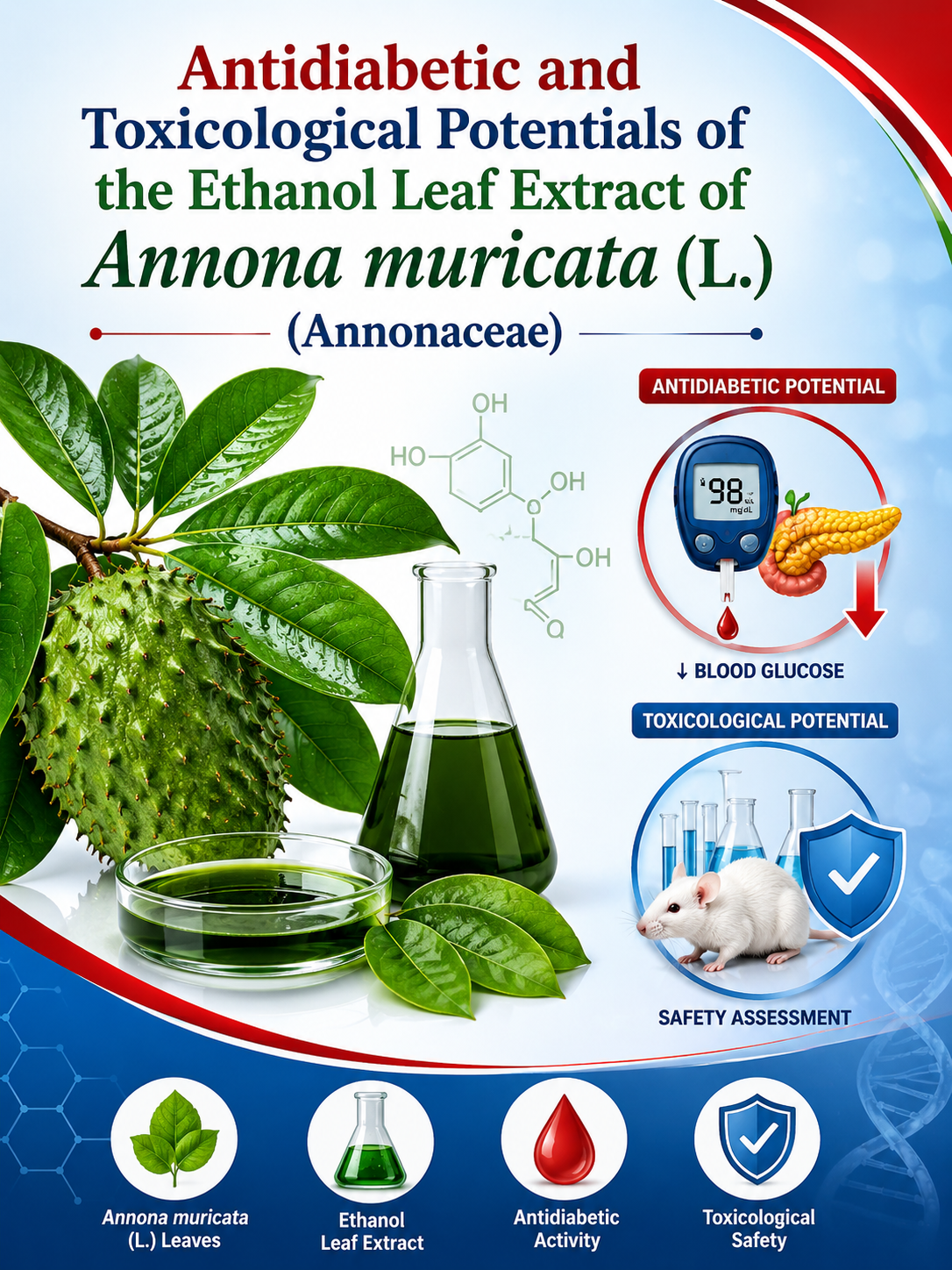
Antidiabetic and Toxicological Potentials of the Ethanol Leaf Extract of Annona muricata (L.) (Annonaceae)
DOI:
https://doi.org/10.59493/advpbl/2026.1.1Keywords:
Annona muricata; Annonaceae; Antidiabetic; ToxicologicalAbstract
Drug resistance and adverse effects plague conventional diabetic treatments. Annona muricata L. (Annonaceae) leaves have been reported to be relatively safe and possess antidiabetic activities amongst other medicinal uses. This study was aimed at confirming the antidiabetic activity of the leaf of A. muricata and evaluating its toxicological profile. Doses of the ethanol extract ranging from 100 – 500 mg/kg were evaluated in normoglycaemic rats. Wistar rats were induced with diabetes by a single intraperitoneal injection of freshly prepared streptozotocin (55 mg/kg body weight). The dose of 500 mg/kg of ethanol extract was administered to the diabetic rats with glibenclamide (1.25 mg/kg) as the reference standard. Acute toxicity of the extract (1-5 g/kg) was tested in Swiss albino mice. Animals were monitored for 10 min after 6 h and for 10 min every day for the next two days. Wistar rats were administered with 5 ml/kg of normal saline (vehicle) and 250 mg/kg of the ethanol extract, respectively for 30 consecutive days. The effects of the extract on the livers, kidneys, hearts, and testes were examined. Various doses of the extract produced a significant (p < 0.05) reduction in blood glucose levels in normoglycaemic and Streptozotocin-induced diabetic rats. The LD50 in mice was above 5 g/kg body weight. Sub-acute evaluation in rats showed that the extract induced a mild chronic inflammation in the testes and epididymis, while in the tissues of the liver, kidney, and heart, the extract provoked a mild chronic inflammatory response, in addition to vascular reactions leading to rupture of the blood vessels and haemorrhage. It was concluded that A. muricata leaves have antidiabetic properties. The inflammatory and immune responses evoked in the sub-acute toxicological evaluation could be a protective response.
References
Sirikhwan T, Chatchawan S, 2020. Evaluation of antioxidant and antimicrobial activities of Vernonia amygdalina leaf extract as an auxiliary in natural hair shampoo. Asian Journal of Pharmaceutical and Clinical Research, 13 (10): 50-57.
Mercy R, David UE, 2018. Natural products as lead bases for drug discovery and development. Research and Reports in Medicinal Sciences, 2: 1-2.
Osibote EA, Olajide OT, 2023. GC-MS analysis of constituents of the essential oil from the leaf and fruit of Nigerian cultivar of Annona muricata. Ife Journal of Science, 25 (1): 87-93.
Abere AT, Onyeabor LU, 2023. Antimicrobial and anti-inflammatory activities of Annona muricata L. (Annonaceae) formulated as herbal toothpaste. Journal of Science and Practice of Pharmacy, 10 (1): 33-542.
Abdul Wahab SM, Jantan I, Haque MA, Arshad L, 2018. Exploring the leaves of Annona muricata L. as a source of potential anti-inflammatory and anticancer agent. Frontiers in Pharmacology, 9: 661.
Ana CT, Efigenia MG, Elhadi MY, Eva NO, 2018. Annona muricata: A review of its traditional medicinal uses, phytochemical, pharmacological activities, mechanism of action and toxicity. Arabian Journal of Chemistry, 11 (5): 662-691.
Mutakin M, Fauziati R, Fadhilah FN, Zuhrotun A, Amalia R, Hadisaputri YE, 2022. Pharmacological activities of Soursop (Annona muricata Linn). Molecules, 27 (4): 1201.
Fofana S, Ziyaev R, Abdulsamatov A, Zakirov SK, 2011. Alkaloids from Annona muricata leaves. Chemistry of Natural Compounds, 47: 321.
Nawawar M, Ayoub N, Hussein S, Hashim A, El-Sharawy R, Wende K, Harms M, Lindequist U, 2012. A flavonol triglycoside and investigation of the antioxidant and cell stimulating activities of Annona muricata Linn. Archives of Pharmaceutical Research, 35: 761-767.
World Health Organisation, 2019. Classification of Diabetes Mellitus. World Health Organisation, Geneva, Swaziland.
Forouhi NG, Wareham NJ, 2019. Epidemiology of diabetes. Medicine, 47 (1): 22-27.
Atun R, Davies JI, Gale EM, Barnighausen T, Beran D, Kengne AP, Werfalli M, 2017. Diabetes in sub-Saharan Africa: from clinical care to health policy. Lancet Diabetes and Endocrinology, 5 (8): 622–667.
Ramzy A, Belmonte PJ, Braam MJ, Ida S, Wilts EM, Levings MK, Rezania A, Kieffer TJ, 2023. A century-long journey from the discovery of insulin to the implantation of stem cell–derived islets. Endocrine Reviews, 44 (2): 222–253.
Das MJ, Banerjee D, Banerjee A, Muchahary S, Sinha A, Gogoi D, Chattopadhyay P, Dasgupta S, Deka SC, 2024. Safety and antidiabetic activity of Lagenaria siceraria (Molina) Standl. Juice in streptozotocin-induced diabetic rats. Journal of Ethnopharmacology, 319: 117111.
Nazir N, Zahoor M, Uddin F, Nisar M, 2021. Chemical composition, in-vitro antioxidant, anticholinesterase and antidiabetic potential of essential oil of Elaeagnus umbellata Thunb. BMC Complementary Medicine and Therapy, 21 (1): 1–13.
Muzumbukilwa WT, Nlooto M, Owira PMO, 2019. Hepatoprotective effects of Moringa oleifera Lam (Moringaceae) leaf extracts in streptozotocin-induced diabetes in rats. Journal of Functional Foods, 57: 75–82.
Mbara KC, Rambharose S, Baijnath H, Nlooto M, Owira PMO, 2022. Antidiabetic effects of Psidium x durbanensis Baijnath & Ramcharun ined. (Myrtaceae) leaf extract in streptozotocin-induced diabetes in rats. Journal of Ethnopharmacology, 297: 115542.
Abere TA, Onwukaeme DN, Ozolua RI, 2017. Antidiabetic activity of isolates from the leaves of Secamone afzelii Rhoem (Asclepiadaceae). African Journal of Pharmaceutical Research, 9 (2): 119-124.
Yunusa IO, Musa BB, Asmau AN, Ruqaya YS, Unekwu HR, 2021.In-vitro anti-inflammatory and analgesic activities of methanol and n-hexane extracts of Phoenix dactylifera fruits. Ghana Journal of Science, 62 (2): 1-15.
Aschwanden C, 2001. Herbs for health, but how safe are they? Bulletin of World Health Organisation, 79 (7): 691-692.
Ezekwesili CN, Obidoa O, Nwodo OFC, Ezekwesili-Ofili JO, 2011. Toxicity of Acalypha tota (MUELL) leaves ethanolic extract in mice and rat. Animal Research International, 8 (1): 1315-1322.
Shilpa R. 2018. Toxicological analysis of herbal drugs – A review. International Journal of Pharmaceutical Sciences Review and Research, 55 (2): 1-6
National Institute of Health, 2002. Public health service policy on humane care and use of laboratory animals. Office of the Laboratory Animal Welfare, USA. 1-19.
Muzumbukilwa WT, Kadima MG, Nlooto M, Owira PMO, 2019. Mapping the evidence of hepatoprotective properties of Moringa oleiferas from Sub-Saharan Africa; a systematic review protocol, Systematic Reviews, 8 (1): 1-6.
Orhan DO, Aslan M, Sendogdu N, Ergun F, Yesilada E, 2005. Evaluation of the hypoglycaemic effect and antioxidant activity of three Viscum album subspecies (European mistletoe) in streptozotocin-diabetic rats. Journal of Ethnopharmacology, 98: 95-102
Rehman MHU, Saleem U, Ahmad B, Rashid M. 2022. Phytochemical and toxicological evaluation of Zephyranthes citrina. Frontiers in Pharmacology, 13: 1007310
Rajeh MAB, Kwan YP, Zakaria Z, Latha LY, Jothy SL, Sasidharan S. 2012. Acute toxicity impacts of Euphorbia hirta L. extract on behavior, organs, body weight and histopathology of organs of the mice and Artemia salina. Pharmacognosy Research, 4 (3): 170-177
Oguntibejin OO. 2019. Hypoglycaemic and anti-diabetic activity of selected African medicinal plants. International Journal of Physiology, Pathophysiology and Pharmacology, 11 (6): 224-237
Akhand RN, Ahmed S, Bhowmike A, Rokeya B. 2013. Sub-Chronic oral administration of the ethanolic extract of dried Terminalia chebula mature fruits in streptozotocin (STZ)-induced type 2 diabetes mellitus (T2DM) model of Lung-Evans (L-E) rats improve glycemic, lipidemic and anti-oxidative status. Journal of Applied Pharmaceutical Sciences, 3 (05): 27-32
Florence NT, Benolt MZ, Jonas K, Alexandra T, Desire DD, Pierre K, Theophile D. 2014. Antidiabetic and antioxidant effects of Annona muricata (Annonaceae) aqueous extract on streptozotocin-induced diabetic rats. Journal of Ethnopharmacology, 151 (2): 784-790
Mohammed A. 2023. Hypoglycemic potential of African medicinal plants in diabetic and non-diabetic human subjects: A review. Clinical Complementary Medicine and Pharmacology, 3(2): 100081.
Garra AH, Eltomy SA, Aarrag HRH, Ahmed NM. 2020. Antidiabetic, antihyperlipidemic and antioxidant activities of Acacia albida in streptozotocin-induced diabetic rats and its metabolites. Egypt Journal of Chemistry, 63 (1): 337-348
Ojo OA, Okesola MA, Ekakite LI, Ajiboye BO, Oyinloye BE, Agboinghale PE, Onikanni AS. 2020. Gongronema latifolium Benth. Leaf extract attenuates diabetic-induced neuropathy via inhibition of cognitive, oxidative stress and inflammatory response. Journal of the Science of Food and Agriculture, 100 (12): 4504-4511
Sherif HB, Baba G, Abdullahi SM. 2018. Acute and sub-chronic toxicity profile of Annona muricata (Sour sop) on Wistar Albino rats. Bayero Journal of Pure and Applied Sciences, 10: 57.
Eggadi V, Gundamedi S, Sheshagiri SBB, Revoori SK, Jupally VR, Kulandaivelu U. 2014. Evaluation of Anticancer activity of Annona muricata in 1, 2-Dimethyl Hydrazine induced colon cancer. World Applied Sciences Journal, 32: 444-450
Zubaidi SN, Oadi WSM, Maarof S, Misnan NM, Noor HSM, Hamezah HS, Baharum SN, Rosli N, Jam FA, Al-Olayan E, Wang C, Hellah K, Buzgaia N, Mediani A. 2023. Assessing the acute toxicological effects of Annona muricata leaf ethanol extract on rats: Biochemical, Histopathological and Metabolomics analysis. Toxics, 11 (8): 688.
Downloads
Published
How to Cite
Issue
Section
License
Copyright (c) 2026 Tavs A. Abere, Ese A. Abere, Ifeanyi H. Osemenam

This work is licensed under a Creative Commons Attribution 4.0 International License.
All articles published in Advanced Pharmaceutical and Biomedical Letters (AdvPBL) are distributed under an Open Access Creative Commons License BY/4.0. Users are allowed to freely download, read, distribute the materials in any medium or format, remix, reuse the articles or quote the articles, so long as proper attribution is given to the original creators (authors and publishers). Articles may be used for commercial or non-commercial purposes. Users are free to disseminate the work to colleagues or wider scientific community. By submitting their article, the author(s) grant publisher permission to publish, including displaying, storing, copying, and reusing their content.