Phytochemical and Antiulcer Study on the Ethanol Leaf Extract and Fractions of Spondias dulcis L. Anacardaceae in Rodents
DOI:
https://doi.org/10.59493/advpbl/2025.1.1Keywords:
Phytochemical; Antiulcer; Leaf; AnacardaceaeAbstract
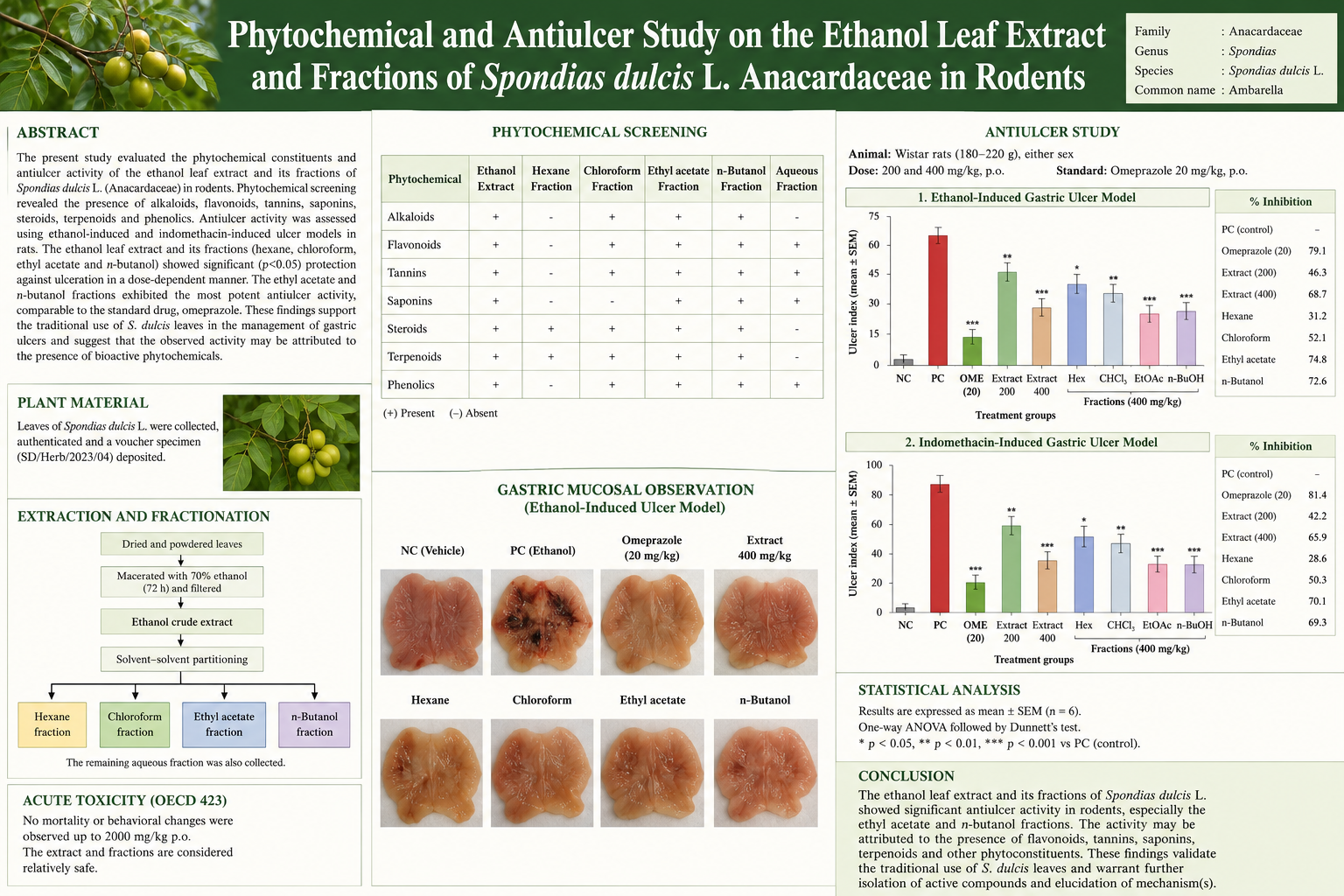
The leaf of Spondias dulcis (Anacardaceae) is used by the indigenes of Usaka in Ikot Ekpene Local Government Area, Akwa Ibom State for the management of abdominal pains/aches. This study was structured to screen the ethanol leaf extract of S. dulcis for phytochemicals, quantify total flavonoids and phenolic contents and also, study its ulcer protective effect. Fresh leaves were shade-dried, milled, macerated with aqueous ethanol (60%) for 72 hours and the filtrate concentrated in vacuo. Part of the crude extract (75g) was partitioned with n-hexane, dichloromethane, ethyl acetate and butanol for their partitioned fractions. Phytochemical screening and quantification were achieved by standard protocols while ulcer protective effect was studied using ethanol and indomethacin ulcer models in rats. Phytochemical screening unveiled the major metabolites present to be flavonoids, alkaloids, saponins, tannins, phlobatannins and terpenoids. The ethanol extract had a total phenolic content of 2.586 mg/g while among the fractions, n-butanol fraction (NBT) revealed the highest total phenolic content of 2.434 mg/g and also, highest flavonoid content of 1.875 mg/g. The ethanol extract of S. dulcis protected the intestinal lining against ulcers in the two experimental models in a dose-related manner. The result of this study supports the folkloric application of S. dulcis leaf in abdominal pain diseases.
References
Olatokunbo IS, Akinjagunla AD, 2020. Ethnobotanical survey of medicinal plants used by the indigenous people of Bayelsa State, Nigeria. International Journal of Engineering Applied Sciences and Technology, 5 (1):768-781.
Mohamad NI, Manan MA, Sani NA, 2022. The antibacterial activity of lactic acid bacteria from pickled Spondias dulcis (Ambarella) against foodborne pathogens. Trends in Sciences, 19(5): 2896-2899.
Etukudo I, 2003. Ethnobotany: conventional and traditional uses of plants. Nigeria, The verdict press, 7-8.
Rahmatullah M, Ferdausi D, Mollik MA, Azam MN, Rahman MT, Jahan R, 2009. Ethnomedical survey of Bheramara area in Kushtia district, Bangladesh. American-Eurasian Journal of Sustainable Agriculture, 3:534–541.
Wiart C, 2006. Medicinal plants of Asia and the Pacific. CRC, New York, 179.
Yunus MSN, Abas F, Jaafar AH, Azizan A, Zolkeflee NKZ, Abd Ghafar SZ, 2021. Antioxidant and α-glucosidase inhibitory activities of eight neglected fruit extracts and UHPLC-MS/MS profile of the active extracts. Food Science and Biotechnology, 30: 195–208.
Daipana WM, Hemb GW, Wamunini EB, Walep LH, 2018. Ethnobotanical survey of wild food plants in Southern Highlands, Enga and Western Highlands Provinces of Papua New Guinea. Ethnobotany Research and Applications, 17: 266-279.
Islam SMA, Ahmed KT, Manik MK, MD, Wahid MA, Kamal CSI, 2013. A comparative study of the antioxidant, antimicrobial, cytotoxic and thrombolytic potential of the fruits and leaves of Spondias dulcis. Asian Pacific Journal of Tropical Biomedicine, 3(9): 682-691.
Araujo CDS, Brito LD, Tarifa MO, Silva NJFD, Rodrigues KS, Cavalcante DGSM, Gomes AS, Zocoler MA, Yoshihara E, Camparoto ML,2019. Protective effects of bark ethanolic extract from Spondias dulcis Forst F. against DNA damage induced by benzo[a]pyrene and cyclophosphamide. Genetics and Molecular Biology, 42: 643–654.
Bohra P, Waman AA, 2017. Spondias dulcis L.: an important acidulant speciesin Bay islands. International Journal of Usufructs Management, 18(1): 25-29.
Iacomini M, Serrato RV, Sassaki GL, Lopes L, Buchi DF, Gorin PAJ, 2005. Isolation and partial characterization of a pectic polysaccharide from the fruit pulp of Spondias cytherea and its effect on peritoneal macrophage activation. Fitoterapia, 76 (7-8): 676–83.
Yolande FN, Sayantan B, Paramita G, Deblina S, Simplice MR, Christopher TB, Murmu N, 2018. Cytotoxic effect of Spondias cytherea fruit extract in murine melanoma model in vivo and in vitro. Journal of Environmental Pathology, Toxicology and Oncology, 37: 231–240.
Sofowara A, 2008. Medicinal plants and traditional medicine in Africa. Spectrum books limited, Ibadan, 199-204.
Kaur C, Kapoor HC, 2002. Antioxidant activity and total phenolic content of some Asian vegetables. International Journal of Food Science and Technology, 37(2):9-26.
Enema OJ, Umoh UF, Johnny II. 2024. Phytochemical profile and in vitro antioxidant evaluation of the root of Dennetia tripetala BAK. F. (Annonaceae). IOSR Journal of Pharmacy, 14 (6): 04- 16.
OECD. 2002. TEST No 423: acute oral toxicity-acute toxic class method, OECD guidelines for testing of chemicals, section 4, Paris, OECD Publishing 14.
Edem UA, Okokon JE, Bassey AL, Iyanyi UL, 2023. Antiulcer activity of leaf extract of Saccharum officinarum. Nigerian Journal of Pharmaceutical and Applied Sciences Research, 12(2): 22-27.
Falcao HS, Leite JA, Barbosa-Filho JM, Athayde-Filho PF, Chaves MCO, Moura MD, Ferreira MF, Almeida ABA, Souza-Brito ARM, Diniz MFF, Batista LM,2008. Gastric and duodenal antiulcer activity of alkaloids: A review. Molecules, 13: 3198–223.
Kim SJ, Lee HJ, Kim BS, Lee D, Lee SJ, Yoo SH, Chang HI, 2011. Antiulcer activity of anthocyanins from Rubus coreanus via association with regulation of the activity of matrix metalloproteinase-2. Journal of Agricultural and Food Chemistry, 59: 11786–11793.
Neto LJL, Ramos AGB, Sales VS, Souza SDG, Santos ATL, Oliverira LR, Kerntopf MR, Albuquerque TR, Coutinho HDM, Quintans-Junior LJ, 2017. Gastroprotective and ulcer healing effects of hydroethanolic extract of leaves of Caryocar coriaceum: Mechanisms involved in the gastroprotective activity. Chemico-Biological Interaction, 261:56–62.
Paguigan ND, Castillo DHB, Chichioco-Hernandez CL, 2014. Anti-ulcer activity of Leguminosae plants. Archives of Gastroenterology, 51:64–68.
Mota KS, Dias GEN, Pinto MEF, Luiz-Ferreira Â, Souza-Brito, ARM , Hiruma-Lima CA, José Barbosa-Filho JM, Batista LM, 2009. Flavonoids with gastroprotective activity. Molecules, 14: 979-1012.
Karampour NS, Arzi A, Rezaie A, Pashmforoosh M, Kordi F, 2019. Gastroprotective effect of zingerone on ethanol-induced gastric ulcers in rats. Medicina (kaunas), 55 (3): 64.
Danisman B, Cicek B, Yildirim S, Bolat I, Kantar D, Golokhvast KS, Nikitovic D, Tsatsakis A, Taghizadehghalehjoughi A, 2023. Carnosic acid ameliorates indomethacin-induced gastric ulceration in rats by alleviating oxidative stress and inflammation. Biomedicines, 11(3): 829.
Okokon JE, Obot J, Amazu LU, 2018. Antiulcerogenic activity of husk extract of Zea mays. African Journal of Pharmacology and Therapeutics, 7(2): 41-45.
Kaan SK, Cho CH, 1996. A study of the antiulcer mechanisms of propranolol in rats. Inflammation Research, 45: 370-375
Okokon JE, Etebong EO, Umoh EE, Essien GE, 2010. Antiulcerogenic activity of ethanolic leaf extract of Hensia crinata. Journal of Pharmacy and Bioresources, 7(2): 114-119.
Okokon JE, Nwafor PA, 2009. Antiulcer and anticonvulsant activity of Croton zambesicus. Pakistan Journal of Pharmaceutical Sciences, 22(4): 384-390.
Downloads
Published
How to Cite
Issue
Section
License
Copyright (c) 2025 Uwemedimo F. Umoh, Onoja J. Enema, Olugbenga A. Ojo, Mathias N. Igwe, Unwana A. Osom, Esther James

This work is licensed under a Creative Commons Attribution 4.0 International License.
All articles published in Advanced Pharmaceutical and Biomedical Letters (AdvPBL) are distributed under an Open Access Creative Commons License BY/4.0. Users are allowed to freely download, read, distribute the materials in any medium or format, remix, reuse the articles or quote the articles, so long as proper attribution is given to the original creators (authors and publishers). Articles may be used for commercial or non-commercial purposes. Users are free to disseminate the work to colleagues or wider scientific community. By submitting their article, the author(s) grant publisher permission to publish, including displaying, storing, copying, and reusing their content.