Antioxidant Activity of Ethanol Leaf Extract of Clerodendrum Splendens G. Don (Verbenaceae)
DOI:
https://doi.org/10.59493/advpbl/2024.1.4Keywords:
Clerodendrum splendens; Ascorbic acid; Antioxidants; Oxidative stressAbstract
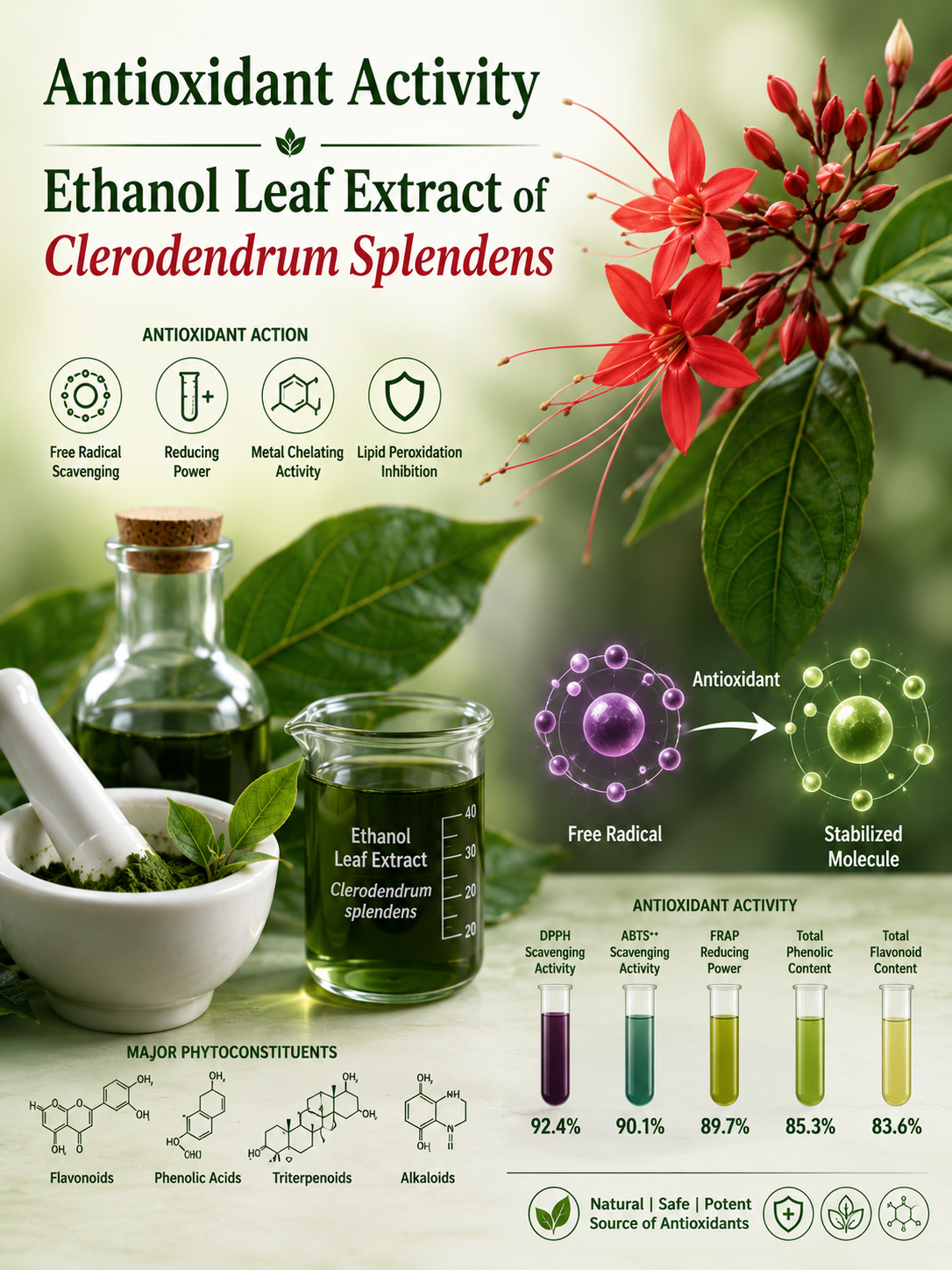
The aim of the study was to evaluate the antioxidant activity of the ethanol leaf extract of Clerodendrum splendens. Three hundred and fifty grams (350 g) of the powdered leaf sample was macerated in 1500 ml of ethanol for 48 hours. The ethanol extract (EE) was partitioned into n-hexane, ethyl acetate and aqueous ethanol using the separating funnel to obtain the respective fractions. Phytochemical screening and acute toxicity studies were conducted for EE. The antioxidant activities of the extracts were analyzed, in comparison with ascorbic acid (AA), using the 1,1-dipheny-2-picrylhydrazyl (DPPH) radical scavenging assay and ferric reducing antioxidant power (FRAP) assay for concentrations of 1, 0.5, 0.25, 0.125 and 0.0625 mg/ml. The percentage inhibition power, IC50 and EC50 values were calculated accordingly. The results of the phytochemical screening showed that alkaloids, tannins, flavonoids, steroids, saponins, glycosides and terpenoids were present in EE. In the acute toxicity study, mice administered a dosage of 5000 mg/kg were without experiencing any fatalities. The DPPH assay indicates that the most active fraction was the aqueous ethanol fraction with the lowest IC50 value of 0.31 mg/ml, while AA had an IC50 value of 0.0285 mg/ml. The FRAP results also indicates that the most active fractions were the ethyl acetate fraction with EC50 values of 0.29 mg/ml, while AA had an EC50 value of 0.057 mg/ml. The antioxidant activity of EE is similar to that of ascorbic acid, and it can be utilized to treat and prevent disorders associated to oxidative stress.
References
Monaghan P, Metcalfe NB, Torres R, 2009. Oxidative as a mediator of life history trade-offs: mechanisms, measurements and interpretations. Ecology Letters, 12 (1): 75-92.
Xu JG, Hu QP, Liu Y, 2012. Antioxidant and DNA-protective activities of chlorogenic acid isomers. Journal of Agricultural and Food Chemistry, 60 (46): 11625–11630.
Niggeweg R, Michael AJ, Martin C, 2004. Engineering plants with increased levels of the antioxidant chlorogenic acid. Nature Biotechnology, 22 (6): 746–754.
Douki T, Cadet J, 2009. Peroxynitrite mediated oxidation of purine bases of nucleosides and isolated DNA. Free Radical Research, 24 (5): 369–380.
Andrew PJ, Mayer B, 1999. Enzymatic function of nitric oxide synthases. Cardiovascular Research, 43 (3): 521–531.
Holmes GE, Bernstein C, Bernstein H, 1992. Oxidative and other DNA damages as the basis of aging: A review. Mutation Research/DNAging, 275 (3-6): 305–15.
Beckman KB, Ames BN, 1998. The free radical theory of ageing matures. Physiological Reviews, 78: 547–581.
Finkel T, Holbrook NJ, 2000. Oxidants, oxidative stress and the biology of ageing. Nature, 408: 239–247.
Rajah MN, Bastianetto S, Bromley-Brits K, Cools R, D’Esposito M, Grady CL, Poirier J, Quirion R, Raz N, Rogaeva E, Song W, Pruessner J, 2009. Biological changes associated with healthy versus pathological aging: A symposium review. Ageing Research Reviews, 8 (2):140–146.
Shrivastava N, Patel T, 2007. Clerondendron and Healthcare. An overview medicinal and Aromatic plant science and Biotechnology 1 (1): 142-150.
Steane DA, Scotland RW, Mabberley DJ, Olmstead RG, 1999. Molecular systematics of Clerodendrum (Lamiaceae): its sequences and total evidence. American Journal of Botany, 86 (1): 98–107.
Starr F, Starr K, Loopel A, 2003. Clerodendron macrostegium. United States Gestogical Survey Biological Resources Division, 3: 21-23.
Sunil BP, Nirmal SA, Sunil PP, 2014. Pharmacognostic Study of Clerodendrum splendens leaves. Inventi Rapid: Planta Activa, 2014 (3): 1-5.
Okwu DE, Iroabuchi F, 2009. Phytochemical composition and biological activities of Uvaria chamae and Clerodendron splendens. E-Journal of Chemistry, 6 (2): 553–560.
Pinto WJ, Nes WR, 1985. 24β-Ethylsterols, n-alkanes and n-alkanols of Clerodendrum splendens. Phytochemistry, 24: 1095–1098.
Shareef IM, Leelavathi S, 2011. Evaluation of antioxidant activity of Anisolmeles malabarica R Br and Clerodendrum serratum L. Extracts against rheumatism. Research Journal of Pharmaceutical, Biological and Chemical Sciences, 2 (4): 488‑495.
Modi AJ, Khadabadi SS, Deore SL, Kubde MS, 2010. Antioxidant effects of leaves of Clerodendrum infortunatum (Linn.). International Journal of Pharmaceutical Sciences and Research, 1: 67-72.
Gurudeeban S, Satyavani K, Ramanathan T, Umamaheshwari G, Shanmugapriya R, 2010. Antioxidant and radical scavenging effect of Clerodendrum inerme (L). World Journal of Fishery and Marine. Science, 2: 66‑69.
Sathish M, Tharani CB, Niraimathi V, 2011. Free radical scavenging activity of various extracts from root of Clerodendrum phlomidis (Linn.) evaluated by three in vitro methods. Research Journal of Pharmaceutical Biological and Chemical Sciences, 2 (3): 752‑61.
Obi PE, Ezeorah CC, Odoh UE, Offiah OR, 2022. Effect of ethanol leaf extract of Clerodendrum splendens (G. Don) (Verbenaceae) on Some Biochemical Parameters of Alloxan-Induced Diabetic Wistar rats. Phytomedicine Plus. https://doi.org/10.1016/j.phyplu.2021.100147
Evans WC, 2009. Pharmacognosy, 5th edn. Saunders, London, p. 585
Harborne JB, 1973. Phytochemical Methods: A Guide to Modern Techniques of Plant Analysis. Chapman and Hall Ltd., London, pp.49-188.
Lorke D, 1983. A new approach to practical acute toxicity testing. Archives of Toxicology, 54: 275–287.
Beatrice MG, Alex KM, Stephen KM, Mathew PN, 2020. In vitro antioxidant activities of methanolic extracts of Caesalpinia volkensii Harmsi, Vernonia lasiopus O. Hoffman, and Acacia hockii De Wild. Evidence-based Complementary and Alternative Medicine, 2020:1-10. https://dio.org/10.1155/2020/3586268
Naveed M, Hejazi V, Abbas M, Kambah AA, Khan GJ, Shumzaid M, Ahmad F, Babazadeh D, FangFang X, Modarresi-Ghazani F, WenHua L, XiaoHui Z, 2018. Chlorogenic acid (CGA). a pharmacological review and call for further research. Biomedicine and Pharmacotherapy, 97: 67–74.
Sridhar K, Charles AL, 2019. In vitro antioxidant activity of Kyoho grape extracts in DPPH and ABTS assays: Estimation methods for EC50 using advanced statistical programs. Food Chemistry, 275: 41–49.
Siddartha B, Riya M, Anjali P, Arpana V, Archana G, 2022. Determination of Antioxidants by DPPH Radical Scavenging Activity and Quantitative Phytochemical Analysis of Ficus religiosa. Molecules, 27 (4): 1326. doi: 10.3390/molecules27041326.
Fidrianny I, Ramadhani S, Komar R, 2015. In vitro antioxidant capacities of three organs of bitter gourd (Momordica charantia L.) form west Java-Indonesia using DPPH and FRAP assays. International Journal of Pharmacognosy and Phytochemical Research, 7 (5): 1034–1041.
Halvorsen BL, Holte K, Myhrstad MCW, Barikmo I, Hvattum E, Remberg SF, 2002. A systematic screening of total antioxidants in dietary plants. Journal of Nutrition, 132 (3): 461–471.
MacDonald-Wicks LK, Wood LG, Garg ML, 2006. Methodology for the determination of biological antioxidant capacity in vitro: a review. Journal of the Science of Food and Agriculture, 86 (13): 2046–2056.
Laeliocattleya RA, Estiasih T, Griselda G, Muchlisyiyah J, 2018. The bioactive compounds and antioxidant activity of ethanol and ethyl acetate extracts of Candi Banana (Musa paradisiaca) IOP Conference Series: Earth and Environmental Science, 131 (2018): 012013.
Downloads
Published
How to Cite
Issue
Section
License
Copyright (c) 2024 Patrick E. Obi, Anne C. Ezeh, Christopher O. Ezeugwu, Christopher E.O. Ugwoke, Sabastine O. Onugwu, Chukwunonso E. Obi, Jude I. Ali, Raymond O. Offiah

This work is licensed under a Creative Commons Attribution 4.0 International License.
All articles published in Advanced Pharmaceutical and Biomedical Letters (AdvPBL) are distributed under an Open Access Creative Commons License BY/4.0. Users are allowed to freely download, read, distribute the materials in any medium or format, remix, reuse the articles or quote the articles, so long as proper attribution is given to the original creators (authors and publishers). Articles may be used for commercial or non-commercial purposes. Users are free to disseminate the work to colleagues or wider scientific community. By submitting their article, the author(s) grant publisher permission to publish, including displaying, storing, copying, and reusing their content.