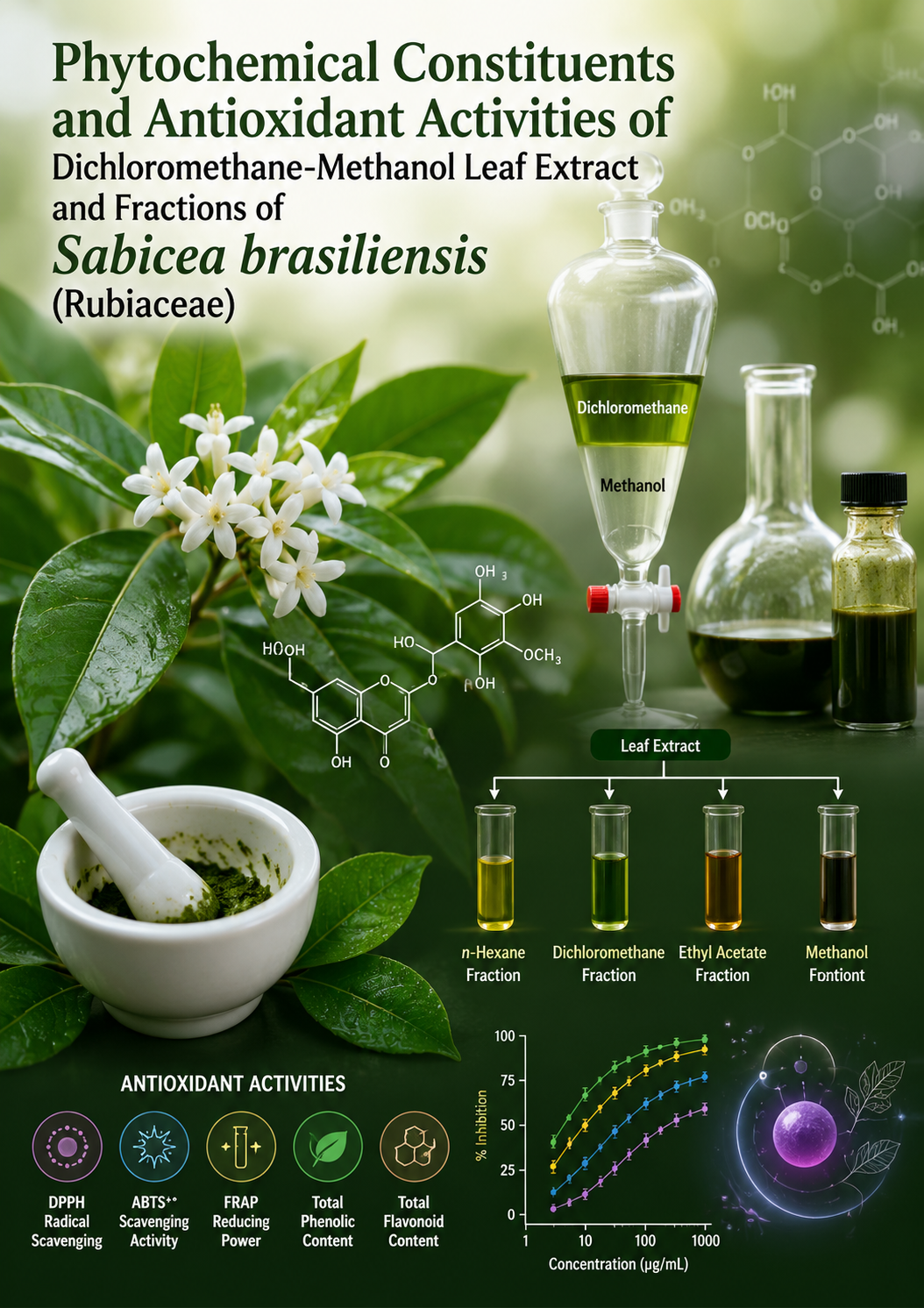
Phytochemical Constituents and Antioxidant Activities of Dichloromethane-Methanol Leaf Extract and Fractions of Sabicea Brasiliensis (Rubiaceae)
DOI:
https://doi.org/10.59493/advpbl/2024.1.2Keywords:
Phytochemical; Antioxidant models; Dichloromethane-Methanol extract; Butanol subfractions; Sabicea brasiliensisAbstract
The objectives of this study were to determine the phytochemical components included in the dichloromethane-methanol (DCM-MeOH) extract of Sabicea brasiliensis and to assess the extract's impact on various antioxidant models. Fresh leaves of S. brasiliensis were processed to a fine powder using a milling machine. A 1000 g of the powdered leaves was extracted with 5 L of a 1:1 dichloromethane-methanol (DCM-MeOH) mixture for 72 h using cold maceration with intermittent vigorous shaking every 6 h. The extract was further fractionated using solvent-solvent partitioning method into n-hexane (SB-HF), ethyl acetate (SB-EF) and n-butanol (SB-BF) with SB-BF exhibiting the highest percentage yield of 62%. The leaf extract of S. brasiliensis was screened for the presence of phytochemicals and the in-vitro antioxidant assays were determined using standard methods. Phenols, tannins, glycosides, saponins, terpenoids, steroids and flavonoids were detected except alkaloids. The DCM-MeOH extract exhibited the most significant amount of phenolics (120.78 ± 1.06 mg), total flavonoids content (318.40 ± 4.03 mg), total tannin content (102.22 ± 7.58 mg) while n-hexane fraction had the least total phenolics content (38.73 ± 4.53 mg), total flavonoids content (149.73 ± 4.53 mg), and total tannin content (30.73 ± 1.53 mg). The IC50 of the anti-radical powers of the extract ranged from 0.943 ± 0.01 µg/mL, 1.060 ± 0.01; to 1.127 ± 0.01 µg/mL, 0.887 ± 0.01 in the methanol and butanol subfractions respectively compared to the ascorbic acid standard (1.164 ± 0.01 µg/mL), the subfractions were more potent. This study provided a scientific validation for the folkloric claims regarding S. brasiliensis with novel anti-oxidative potentials.
References
Kakouri E, Daferera D, Paramithiotis S, Astraka K, Drosinos EH, Polissiou MG, 2017. Crocus sativus L. Tepals: The natural source of antioxidant and antimicrobial factors. Journal of Applied Research on Medicinal Aromatic Plants, 4:66-74.
Akoué GN, Obame LC, Ondo JP, Brama I, N’Nang ESO, Tapoyo SY, 2013. Phytochemical composition and antiradical activity of Sakersia africana Hook. F. Medicinal Plant from Gabon. International Journal of Biomolecules and Biomedicine, 3(3): 1-8.
Rahman MA, Imran TB, Islam S, 2013. Antioxidative, antimicrobial and cytotoxic effects of the phenolics of Leea indica leaf extract. Saudi Journal of Biological Sciences, 20(3): 213-25.
Ajitha B, Reddy AK, Reddy PS, 2015. Green synthesis and characterization of silver nanoparticles using Lantana camara leaf extract. Materials Science and Engineering, 49:373–381.
Zulbayu LOMA, Lukitaningsih ER, Rumiyatu R, 2021. GC-MS analysis of bioactive compounds in ethanol and ethyl acetate fraction of grape fruit (Citrus maxima L.) Rind. Borneo Journal of Pharmacy, 4(1): 29-35.
Salisbury BH, Tadi P, 2021. 5 alpha reductase inhibitors. In: Stat pearls (internet). Stat Pearls Publishing, Treasure Island (FL), pp. 4.
Kim S, Kim DB, Jin W, Park J, Yoon W, Lee Y, 2017. Comparative studies of bioactive organosulphur compounds and antioxidant activities in garlic (Allium sativum L.), elephant garlic (Allium ampeloprasum L.) and onion (Allium cepa L.). Natural Product Research, 32 (10):1193-1197.
Heer A, Guleria.S, Razdan VK, 2017. Chemical composition, antioxidant and antimicrobial activities and characterization of bioactive compounds from essential oil of Cinnamomum tamala grown in north-western Himalaya. Journal of Plant Biochemistry and Biotechnology, 26:191-198.
Bashir L, Saidu S, Amos S, Onikanni D, Yunusa OI, Abdulhakeem RA, Halimat YL, Femi O, Ali AJ, Gaber EB, Shukurat BB., Gomaa M, Clara MGL, Alexander TH, Wu HH, Carlos, AC, 2022. Preclinical anti-inflammatory and antioxidant effects of Azanza garckeana in STZ-induced glycemic-impaired rats, and Pharmacoinformatics of it major phytoconstituents: Biomedicine & Pharmacotherapy, 152:113-196.
Baba H, Ibe AC, Kashimawo AJ, 2021. Phytochemical Evaluation and GC-MS Profiling of the Dichloromethane and Ethanol extracts of Ocimum gratissimum L. and Lasianthera africana. Vol 20(2): 640– 655.
Agbo MO, Uzor PF, Akazie-Nneji UN, Eze-Odurukwe CU, Ogbatue UB, Mbaoji EC, 2015. Total Phenolics and flavonoid contents in selected Nigerian Medicinal Plants. Dhaka Journal of Pharmaceutical Sciences, 14 (1): 35-41
Ugorji CO, Ihedioha JN, Agbo MO, Ekere NR, Nwafor, FI, Odoemelam EI, 2019. Antimicrobial and Antioxidant Studies of the Leaf Extract and Fractions of Sabicea brevipes Wernham (Rubiaceae), International Journal of Biochemistry Research & Review, 27 (2): 9-10.
Harbone JB, 1984. Phytochemical Methods: A Guide to Modern Techniques of Plant Analysis, 2nd edition; London: Chapman and Hull, p. 287.
Sahreen S, Muhammad RK, Rahmat AK, 2011. Phenolic compounds and antioxidant activities of Rumex hastatus D.Don. Leaves. Journal of Medicinal Plants Research, 5 (13): 2755-2765.
Biju J, Sulaiman CT, Satheesh G, Reddy VRK, 2014. Total phenolics and flavonoids in selected medicinal plants from Kerala. International Journal of Pharmaceutical Sciences, 6: 406 408.
Abdelwahab SI, Abdul AB, Elhassan MM, Mohan S, Mariod AA, 2010. Phenolic Content and antioxidant activities of Goniothalamus umbrosus extracts. International Journal of Natural Product of Pharmaceutical Sciences, 2: 1-6.
Farhat MB, Landoulsi A, Chaouch-Hamada R, Sotomayor JA, María JJ, 2013. Characterization and quantification of phenolic compounds and antioxidant properties of Salvia species growing in different habitats. Industrial Crops Products, 49: 904– 914.
Aftab S, Krupadam RJ, Rao CK, 2018. Phytochemistry: A succinct overview. Phytochemistry: Research Progress, 1-11.
Alisi CS, Ojiako OA, Osuagwu CG, Onyeze GOC, 2011. Free Radical Scavenging and In-vitro Antioxidants Effects of Ethanol Extract of the Medicinal Herb Chromolaena odorata Linn, British Journal of Pharmaceutical Research, 1: 141.
Mythili K, Reddy CU, Chamundeeswari D, Manna PK, 2014. .Determination of Total Phenol, Alkaloid, Flavonoid and Tannin in different Extracts of Calanthe triplicate. Journal of Pharmacognosy and Phytochemistry, 2 (2): 40-44.
Singh R, Verma PK, Singh G, 2012.Total phenolic, flavonoids and tannin contents in different extracts of Artemisia absinthium. Journal of Intercult Ethnopharmacology, 1 (2): 101-104.
Silva KC, Matos MCS, Maciel MAM, Rolim Neto PJ, Rolim LA, Rolim CM, 2010. Medicinal uses and chemical constituents of Sabicea brasiliensis (Vell.) B. Gates (Rubiaceae). Brazilian Journal of Pharmaceutical Sciences, 46(2): 263-269.
Pérez-Jiménez J, Saura-Calixto F, 2006. Effect of solvent and certain food constituents on different antioxidative activity determinations. Journal of Agricultural and Food Chemistry, 54(13): 4942-4948.
Pérez-Jiménez J, Neveu V, Vos F, Scalbert A, 2010. Systematic analysis of the content of 502 polyphenols in 452 foods and beverages: An application of the Phenol-Explorer database. Journal of Agricultural and Food Chemistry, 58(8): 4959-4969.
Igbinosa OO, Igbinosa IH, Chigor VN, Uzunuigbe OE, Oyedemi SO, Odjadjare EE, 2011. Polyphenolic contents and antioxidant potential of stem bark extracts from Jatropha curcas (Linn). International Journal of Molecular Sciences, 12(5): 2958-71.
Arunkumar E, Muthuselvam M, 2009. Analysis of phytochemical constituents and antioxidant activities of Aloe vera gel extracted from plants in southern Tamil Nadu, India. Plants foods for human nutrition, 64(1): 55-60.
Oboh G, Puntel RL, Rocha JB, 2016. Hot pepper (Capsicum spp.) in polyphenol-rich diets protects brain and key biomolecules against nitrosodiethylamine (NDEA)-induced oxidative stress in rats. Phytotherapy Research, 30(5): 838-847.
Pohanka M, 2021. The Concept of Antioxidant Capacity: From Definition to Implementation. Oxidative Medicine and Cellular Longevity.
Ben MA, Porter EA, Kite GC, Simmonds MS, Abdelhedi R, Bouaziz M, 2015. Phenolic profile characterization of Chemlali olive stones by liquid chromatography-ion trap mass spectrometry. Journal of Agriculture and Food Chemistry, 63(7): 1990-1995.
Alexei YB, Joseph IS, Olga VF, 2009. Endogenous cardiotonic steroids: Physiology, Pharmacology and novel therapeutic targets. Pharmacological Reviews, 61: 9–38.
Vladimir K, Ludmila M, 2001. Glycosides in Medicine: “The role of glycosidic residue in biological activity”. Current Medicinal Chemistry, 8: 1303-1328.
Downloads
Published
How to Cite
Issue
Section
License
Copyright (c) 2024 Chimaobi Odinaka Ugorji, Dinebari Philip Berebon, Paul Chinwuba, Esso Jean-Luc Meledje, Samuel Ibezim Orjiocha, Chioma Obiageli Onyesife, Nonso Richards Ndubuisi, Gladys Ndidiamaka Ugwu

This work is licensed under a Creative Commons Attribution 4.0 International License.
All articles published in Advanced Pharmaceutical and Biomedical Letters (AdvPBL) are distributed under an Open Access Creative Commons License BY/4.0. Users are allowed to freely download, read, distribute the materials in any medium or format, remix, reuse the articles or quote the articles, so long as proper attribution is given to the original creators (authors and publishers). Articles may be used for commercial or non-commercial purposes. Users are free to disseminate the work to colleagues or wider scientific community. By submitting their article, the author(s) grant publisher permission to publish, including displaying, storing, copying, and reusing their content.